
October 17, 2026
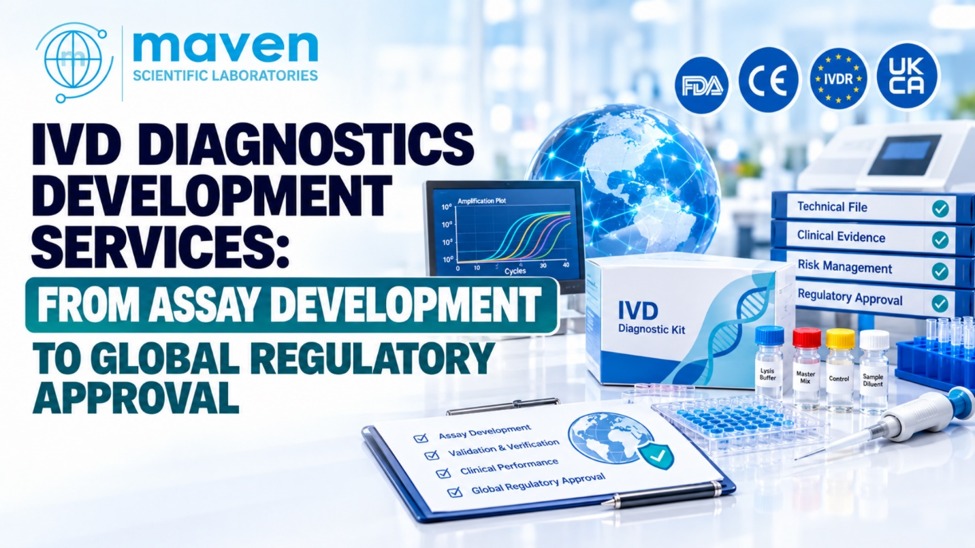
The development of in vitro diagnostic (IVD) products requires more than analytical assay development. Successful commercialization depends on a coordinated approach covering biomarker strategy, assay development, analytical validation, clinical performance, quality systems, regulatory strategy and global market authorization.
For diagnostic developers, pharmaceutical companies, biotechnology organizations and emerging medtech companies, regulatory expectations continue to evolve across major markets. An effective IVD development strategy therefore needs to consider regulatory requirements from the earliest stages of product development rather than treating regulatory compliance as a final submission activity.
Maven Regulatory Solutions supports organizations throughout the IVD development lifecycle, helping align scientific development with regulatory and quality requirements for market access.
What Is IVD Diagnostics Development?
IVD diagnostics are medical devices designed to examine specimens obtained from the human body outside the body to provide information related to disease, physiological conditions, infection, treatment response or other clinical parameters.
IVD development can involve a broad range of technologies, including:
- Molecular diagnostics
- Immunoassays
- NGS-based diagnostics
- PCR and qPCR assays
- Digital and genomic diagnostics
- Biomarker assays
- Companion diagnostic-related assays
- Infectious disease tests
- Oncology diagnostics
- Genetic and inherited-disease testing
- Laboratory-developed and clinical trial assays
Each diagnostic product may require a different development and regulatory pathway depending on its intended use, technology, risk classification, target population and jurisdiction.
Why Regulatory Strategy Should Begin Early
A common challenge in diagnostic development is establishing the regulatory strategy after the assay has already been designed.
However, decisions made during early development can directly affect:
Intended use → Risk classification → Assay design → Validation strategy → Clinical evidence → Regulatory submission → Market authorization
An early regulatory assessment can help identify the evidence needed to support the intended claims and reduce the possibility of redesign, additional validation or delayed submissions later in development.
Maven helps organizations establish a regulatory roadmap that connects scientific development with applicable regulatory expectations.
IVD Assay Development and Optimization
The analytical performance of an IVD is central to its overall development program.
Depending on the diagnostic technology, development activities may include:
- Biomarker selection
- Target identification
- Assay concept development
- Platform selection
- Reagent optimization
- Sample matrix assessment
- Calibration strategy
- Cutoff determination
- Analytical sensitivity assessment
- Analytical specificity assessment
- Precision and reproducibility evaluation
- Interference and cross-reactivity assessment
- Stability assessment
- Reference range development
The objective is to establish an essay that can generate reliable and reproducible results under defined conditions.
Analytical Validation for IVD Products
Analytical validation provides evidence that the diagnostic test performs consistently for its intended analytical purpose.
Key validation considerations may include:
1. Accuracy and Precision
Assessment of assay performance across relevant operators, instruments, sites, runs and testing conditions.
2. Analytical Sensitivity
Determination of the lowest concentration or level that can be detected or measured.
3. Analytical Specificity
Evaluation of the assay's ability to detect the intended analyte without unacceptable interference from other substances or closely related targets.
4. Linearity and Measuring Range
Establishment of the range over which the assay provides reliable and appropriately proportional results.
5. Reproducibility
Assessment of performance across relevant variables such as laboratories, operators, instruments, days and reagent lots.
6. Interference and Cross-Reactivity
Evaluation of substances or biological conditions that could influence assay results.
7. Stability
Assessment of reagent, specimen and product stability under applicable storage and handling conditions.
8. Clinical Performance and Evidence Generation
Analytical performance alone may not be sufficient to support commercialization.
Depending on the product and intended use, developers may need clinical evidence demonstrating that the diagnostic performs appropriately in the intended population.
Clinical development may include:
- Clinical study strategy
- Protocol development
- Site and investigator support
- Specimen strategy
- Clinical performance evaluation
- Statistical analysis
- Clinical evidence generation
- Clinical study reports
- Regulatory submission support
The evidence strategy should be aligned with the intended use, claims and regulatory pathway.
IVD Regulatory Pathways Across Global Markets
IVD regulatory requirements vary between jurisdictions.
1. United States
In the United States, IVDs are regulated by the FDA under the medical device framework. Depending on classification and product characteristics, potential pathways may include:
- 510(k)
- De Novo
- PMA
- EUA, where applicable
- Pre-submission interactions
The regulatory strategy should be established according to the device's intended use, risk profile, technological characteristics and applicable FDA requirements.
2. European Union
In Europe, IVDs are regulated under the EU In Vitro Diagnostic Medical Devices Regulation (IVDR).
Developers may need to address:
- Classification
- Performance evaluation
- Analytical performance
- Scientific validity
- Clinical performance
- Technical documentation
- Quality management
- Post-market surveillance
- Performance studies
- Notified Body requirements, where applicable
3. United Kingdom
UK market access may require consideration of UK-specific requirements, including applicable UKCA and MHRA processes, depending on the product and transition arrangements in force.
4. Other Global Markets
Maven can also support regulatory strategies across additional international markets, helping companies assess local registration, documentation, representation, labeling and post-market obligations.
IVD Quality Management Systems
A strong quality management framework is essential for IVD development and commercialization.
Quality activities may include:
- Design controls
- Document control
- Change control
- Risk management
- Supplier qualification
- CAPA
- Complaint management
- Nonconformance management
- Validation
- Training
- Internal audits
- Post-market surveillance
The quality system should support the entire product lifecycle rather than only the regulatory submission.
Software, Data and Digital IVD Considerations
Modern diagnostics increasingly incorporate software, algorithms, digital interpretation and data-driven analysis.
Developers may therefore need to evaluate:
- Software lifecycle controls
- Algorithm validation
- Cybersecurity
- Data integrity
- Version control
- Change management
- Performance monitoring
- Human factors
- Clinical validation
Where software contributes directly to diagnostic interpretation, its regulatory significance should be incorporated into the overall product strategy.
IVD Labeling and Regulatory Documentation
Regulatory documentation is needed to communicate the intended use and limitations of the product clearly.
Key documents may include:
- Intended-use statement
- Instructions for use
- Labels
- Performance documentation
- Risk-management documentation
- Technical documentation
- Clinical evidence
- Analytical validation reports
- Stability data
- Manufacturing information
- Post-market documentation
Labeling claims should be supported by appropriate evidence and remain consistent with the regulatory submission.
FAQs
1. What is IVD diagnostics development?
IVD diagnostics development involves the scientific, analytical, clinical, quality and regulatory activities required to develop an in vitro diagnostic product from concept through commercialization.
2. When should regulatory planning begin?
Regulatory planning should ideally begin during early development. Intended use, classification and regulatory pathway can influence assay design, validation and clinical evidence requirements.
3. What validation is required for an IVD?
Requirements depend on the product and intended use but may include accuracy, precision, analytical sensitivity, specificity, reproducibility, interference, cross-reactivity, linearity and stability.
4. Does every IVD require clinical evidence?
Clinical evidence requirements depend on the product, intended use, classification and applicable regulatory pathway. Developers should establish the evidence strategy before beginning pivotal studies.
5. Can IVD developers obtain support across multiple markets?
Yes. A global regulatory strategy can evaluate requirements across markets such as the United States, European Union, United Kingdom and other jurisdictions.
Conclusion
IVD diagnostics requires close coordination between science, assay development, clinical evidence, quality systems and regulatory strategy.
A well-designed development program can help organizations identify regulatory requirements early, generate appropriate evidence and prepare for market authorization.
From biomarker strategy and assay development to analytical validation, clinical evidence, technical documentation and regulatory submission, every stage contributes to the final compliance profile of an IVD product.
Maven Regulatory Solutions supports diagnostic developers with integrated regulatory, quality and development expertise designed to help organizations move from diagnostic concept to compliant market access.
How Maven Regulatory Solutions Can Help
Maven Regulatory Solutions can support IVD developers with:
- IVD Regulatory Strategy
- Diagnostic Product Classification
- Assay Development Support
- Analytical Validation Strategy
- Clinical Performance Strategy
- IVDR Compliance
- FDA IVD Regulatory Support
- 510(k), De Novo & PMA Strategy
- Technical Documentation
- Risk Management
- Quality Management Support
- Labeling & IFU Review
- Regulatory Submission Support
- Post-Market Compliance
- Global IVD Market Access
Maven Regulatory Solutions — Science. Compliance. Impact.

Post a comment