
July 03, 2026
Understanding ICH M7 Requirements, Computational Toxicology, (Q)SAR Methodologies, Mutagenic Impurity Risk Assessment, and Best Practices for Regulatory Compliance
The adoption of the International Council for Harmonization (ICH) M7 Guideline marked a significant milestone in pharmaceutical regulatory science by formally recognizing computational toxicology as a scientifically accepted approach for assessing mutagenic impurities.
For the first time, an internationally harmonized guideline recommended the use of (Quantitative) Structure–Activity Relationship [(Q)SAR] methodologies as part of a regulatory testing strategy to predict bacterial mutagenicity without relying solely on laboratory testing.
Since its initial publication and subsequent updates, ICH M7 has become a cornerstone of impurity risk assessment, enabling pharmaceutical manufacturers to identify, classify, and control DNA-reactive (mutagenic) impurities while supporting patient safety and reducing unnecessary animal testing.
As regulatory expectations continue to evolve, companies should strengthen their computational toxicology capabilities and ensure that (Q)SAR assessments are scientifically robust, well-documented, and compliant with current regulatory standards.
Without an initiative-taking (Q)SAR strategy, organizations may face:
- Regulatory compliance challenges
- Delays in impurity qualification
- Additional data requests from health authorities
- Increased development timelines
- Higher laboratory testing costs
- Incomplete mutagenic risk assessments
- Documentation deficiencies
- Product registration delays
- Lifecycle management challenges
- Increased regulatory scrutiny.
As global regulatory agencies continue to encourage science-based, alternative assessment methods, pharmaceutical companies should integrate validated (Q)SAR methodologies into their impurity control strategies.
Executive Overview
ICH M7 introduced a modern, risk-based approach for evaluating mutagenic impurities by incorporating computational toxicology into pharmaceutical development.
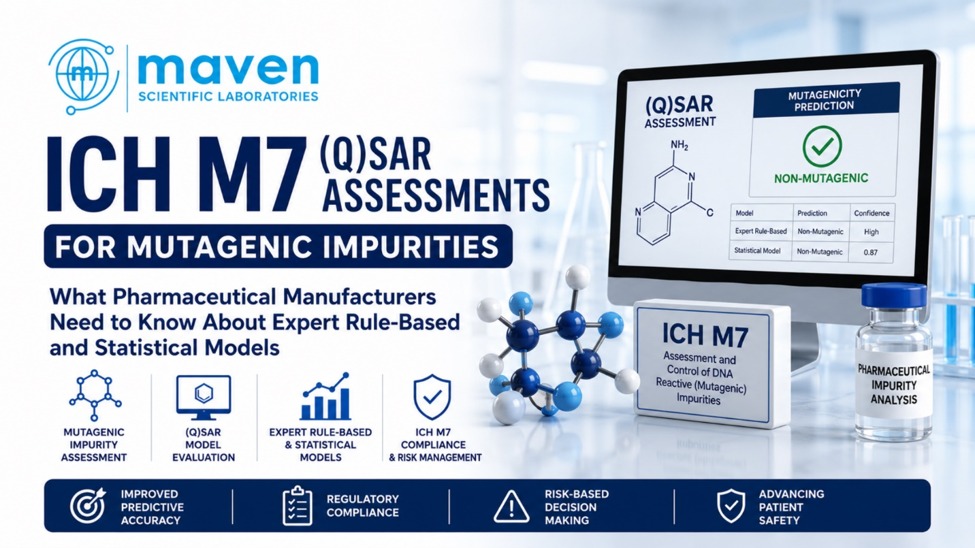
Rather than relying exclusively on experimental testing, the guideline recommends using two complementary (Q)SAR methodologies to predict bacterial mutagenicity and support impurity classification.
A future-ready mutagenic impurity assessment program should be:
- ICH M7 compliant
- OECD aligned
- Scientifically robust
- Risk based
- Computationally validated
- Technically documented
- Quality integrated
- Inspection ready
- Lifecycle managed
Organizations investing in computational toxicology and regulatory intelligence are better positioned to meet evolving global regulatory expectations.
Why ICH M7 Matters
Mutagenic impurities have the potential to damage DNA, increasing the theoretical risk of carcinogenicity if present above acceptable limits.
ICH M7 provides a harmonized framework for identifying and controlling these impurities throughout the pharmaceutical product lifecycle.
The guideline promotes:
- Improved patient safety
- Risk-based decision making.
- Scientific consistency
- Efficient impurity assessment
- Reduced animal testing
- Global regulatory harmonization
- Better product quality
By integrating computational toxicology into regulatory decision-making, ICH M7 enables faster and more efficient impurity evaluations.
Understanding (Q)SAR in ICH M7
(Q)SAR combines computational methods with toxicological science to predict whether a chemical structure is likely to be mutagenic.
Instead of performing laboratory testing for every impurity, validated computational models analyze chemical structures and estimate the likelihood of bacterial mutagenicity based on existing scientific knowledge and experimental datasets.
ICH M7 recommends using two complementary prediction methodologies:
- Expert Rule-Based Models
- Statistical (Q)SAR Models
Using both approaches improves prediction confidence and provides a more comprehensive scientific assessment.
Expert Rule-Based Models
Expert rule-based systems evaluate chemical structures using established Structure–Activity Relationships (SAR).
These models rely on expert knowledge developed through decades of toxicological research, identifying structural alerts associated with bacterial mutagenicity.
Typical characteristics include:
- Knowledge-based predictions
- Structural alert identification
- Mechanistic interpretation
- Transparent scientific rationale
- Expert-reviewed rules
- Biological relevance
Rule-based systems are particularly useful for identifying known mutagenic structural features.
Statistical (Q)SAR Models
Statistical models establish quantitative relationships between molecular structure and biological activity using computational algorithms.
These models analyze large datasets containing chemicals with known outcomes to identify patterns associated with toxicological activity.
Modern statistical models may incorporate:
- Machine learning
- Regression analysis
- Pattern recognition
- Molecular Descriptors
- Large training datasets
- Predictive analytics
Unlike rule-based systems, statistical models can identify both structural features associated with mutagenicity and mitigating features that may reduce mutagenic potential.
Why Two Complementary Models Are Required
ICH M7 recommends combining expert rule-based and statistical models because each approach provides unique scientific strengths.
| Methodology | Primary Strength |
| Expert Rule-Based | Mechanistic Interpretation |
| Statistical (Q)SAR | Data-Driven Prediction |
| Combined Assessment | Higher Confidence |
Using both methodologies improves prediction accuracy while reducing uncertainty.
Key Drivers Behind ICH M7 (Q)SAR Adoption
| Regulatory Driver | Industry Impact |
| ICH M7 Guideline | Harmonized Risk Assessment |
| Computational Toxicology | Reduced Experimental Testing |
| OECD Validation Principles | Reliable Model Performance |
| Patient Safety | Improved Impurity Control |
| Risk-Based Regulation | Efficient Development |
| Scientific Advances | Better Predictive Capability |
Top 5 Compliance Priorities for Pharmaceutical Manufacturers
1. Implement Validated (Q)SAR Assessments
Organizations should ensure computational evaluations use scientifically validated methodologies consistent with OECD principles.
Assessment should include:
- Expert rule-based evaluation
- Statistical model evaluation
- Applicability domain assessment
- Prediction confidence review
- Expert interpretation
2. Strengthen Mutagenic Impurity Risk Assessments
Companies should evaluate:
- Starting materials
- Intermediates
- Process impurities
- Degradation products
- Potential carry-over impurities
Early risk assessment supports efficient pharmaceutical development.
3. Ensure OECD Validation Compliance
ICH M7 recommends using models developed according to internationally recognized OECD validation principles.
Organizations should verify:
- Model validation
- Scientific transparency
- Defined applicability domains
- Predictive performance
- Reproducibility
Validated models increase regulatory confidence.
4. Maintain Comprehensive Documentation
Successful submissions require detailed documentation including:
- Computational reports
- Scientific justification
- Expert review
- Model outputs
- Weight-of-evidence assessment
- Regulatory rationale
Well-documented assessments support smoother regulatory review.
5. Integrate (Q)SAR into Quality Systems
Computational toxicology should become part of broader pharmaceutical quality management.
Best practices include:
- SOP development
- Cross-functional reviews
- Lifecycle updates
- Change management.
- Periodic reassessment
- Regulatory intelligence
Integration strengthens long-term compliance.
The Growing Role of Computational Toxicology
Advances in computational science continue transforming pharmaceutical development through:
- Artificial Intelligence
- Machine Learning
- Big Data Analytics
- Predictive Toxicology
- Digital Risk Assessment
- Alternative Testing Strategies
These innovations support faster, more efficient, and scientifically robust regulatory decision-making.
Practical Benefits of Early (Q)SAR Implementation
| Business Area | Potential Benefit |
| Regulatory Compliance | Reduced Review Risk |
| Product Development | Faster Assessments |
| Laboratory Resources | Reduced Testing |
| Documentation | Improved Consistency |
| Lifecycle Management | Better Change Control |
| Patient Safety | Stronger Risk Assessment |
Important Compliance Considerations
Organizations should establish procedures for:
- Comprehensive impurity reviews
- (Q)SAR evaluations
- Expert interpretation
- Documentation updates
- Scientific literature monitoring
- Regulatory intelligence
- Cross-functional review
- Periodic reassessment
(Q)SAR assessments should be managed as an ongoing regulatory activity, not treated as a one-time submission requirement.
Best Practices for ICH M7 Compliance Excellence
Conduct Comprehensive Impurity Assessments
Manufacturers should periodically evaluate:
- Process impurities
- Degradation products
- Synthetic intermediates
- Structural alerts
- Computational predictions
- Weight-of-evidence conclusions
Strengthening Cross-Functional Collaboration
Successful implementation requires collaboration among:
- Regulatory Affairs
- Toxicology
- Pharmaceutical Development
- Quality Assurance
- Analytical Development
- Manufacturing
- Clinical Safety
- Pharmacovigilance
Improve Regulatory Intelligence
Organizations should continuously monitor:
- ICH guideline updates
- Regulatory agency expectations
- OECD developments
- Scientific publications
- Emerging computational technologies
- Industry best practices
Emerging Trends in Computational Toxicology
| Emerging Trend | Industry Impact |
| Artificial Intelligence | Improved Predictive Accuracy |
| Machine Learning | Faster Risk Assessments |
| Digital Toxicology | Better Decision Support |
| Integrated Testing Strategies | Reduced Animal Testing |
| Regulatory Harmonization | Greater Global Consistency |
| Lifecycle Risk Management | Continuous Compliance |
Computational toxicology is becoming an increasingly key component of modern pharmaceutical regulation.
Why ICH M7 Continues to Shape Pharmaceutical Development
ICH M7 represents one of the most influential regulatory advances in impurity risk assessment by integrating computational toxicology into pharmaceutical quality and safety evaluation.
Organizations that strengthen:
- Computational toxicology capabilities
- Scientific expertise
- Regulatory intelligence
- Documentation quality
- Quality systems
- Cross-functional collaboration
will be better positioned to support efficient product development and long-term regulatory compliance.
Computational toxicology is no longer an emerging technology it is an established regulatory expectation.
How Maven Supports Pharmaceutical Companies
Our Expertise Includes
- ICH M7 compliance consulting
- (Q)SAR assessment support
- Mutagenic impurity risk assessments
- Computational toxicology consulting
- Regulatory strategy
- Technical documentation support
- Impurity control strategies
- Regulatory intelligence
- Global pharmaceutical compliance
Why Companies Choose Maven
- Deep pharmaceutical regulatory expertise
- Scientific toxicology specialists
- Risk-based regulatory approach.
- End-to-end compliance support
- Global regulatory experience
- Practical implementation strategies
- Strong technical documentation capabilities
Conclusion
The ICH M7 guideline transformed pharmaceutical impurity assessment by recognizing validated (Q)SAR methodologies as a key component of mutagenic risk evaluation.
By combining expert rule-based and statistical computational models, pharmaceutical manufacturers can improve prediction confidence, strengthen regulatory submissions, reduce unnecessary testing, and support patient safety.
Organizations that invest in computational toxicology, regulatory intelligence, robust documentation, and lifecycle impurity management will be better prepared for evolving global regulatory expectations.
The future of pharmaceutical compliance extends beyond laboratory testing it increasingly relies on scientifically validated computational approaches that support faster, smarter, and more efficient regulatory decision-making.
Frequently Asked Questions
1. What is ICH M7?
ICH M7 is an international guideline that provides a risk-based framework for assessing and controlling DNA-reactive (mutagenic) impurities in pharmaceuticals.
2. What is (Q)SAR?
(Q)SAR stands for (Quantitative) Structure–Activity Relationship, a computational method used to predict the biological activity of chemicals based on their molecular structure.
3. Why does ICH M7 recommend two (Q)SAR methodologies?
Using both expert rule-based and statistical models provides complementary evidence, improving prediction reliability and confidence.
4. What are OECD validation principles?
They are internationally recognized principles for validating computational models to ensure reliability, transparency, and regulatory acceptance.
5. Can (Q)SAR replace laboratory testing?
In many cases, validated (Q)SAR assessments can support impurity classification without additional bacterial mutagenicity testing, depending on the regulatory context and available evidence.
6. What are the benefits of computational toxicology?
It improves efficiency, supports risk-based decision-making, reduces unnecessary testing, and enhances regulatory consistency.
7. Which pharmaceutical products are affected by ICH M7?
The guideline applies to pharmaceuticals where assessment of DNA-reactive (mutagenic) impurities is required during development and lifecycle management.
8. How can Maven help?
Maven provides expert support for ICH M7 compliance, (Q)SAR evaluations, mutagenic impurity assessments, computational toxicology consulting, technical documentation, and global regulatory strategy.

Post a comment