
October 01, 2026
What the Mandatory REP Requirements Mean for Medical Device Manufacturers Seeking Canadian Market Access
For medical device manufacturers seeking or maintaining market access in Canada, regulatory submission readiness now extends beyond completing the technical dossier.
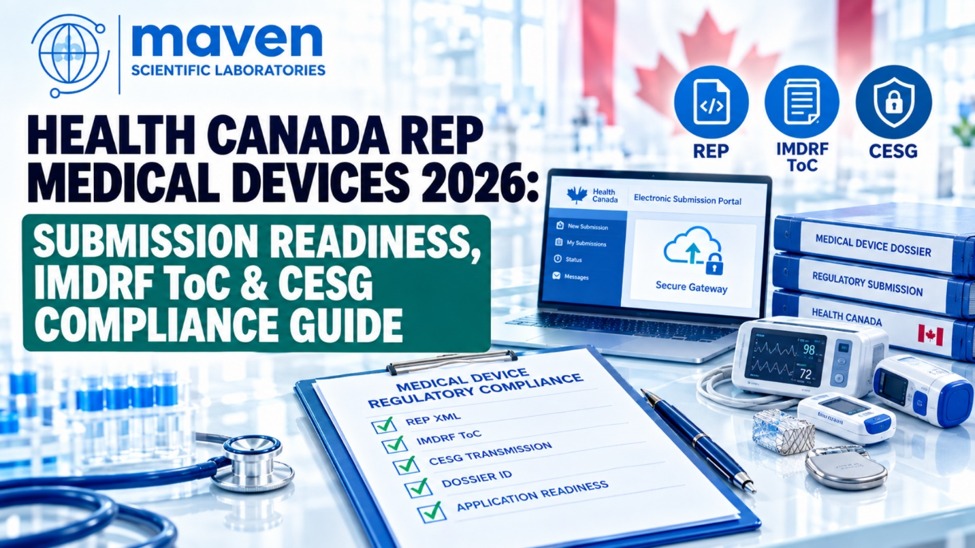
As of 1 April 2026, Health Canada requires the Regulatory Enrolment Process (REP) and Common Electronic Submissions Gateway (CESG) for medical device transactions within the applicable mandatory scope. Covered submissions must also follow the applicable International Medical Device Regulators Forum (IMDRF) Table of Contents (ToC) structure.
The change is more than a transition from conventional application forms to XML-based regulatory information.
Under REP, a technically complete dossier may still not be filing-ready if company information, regulatory identifiers, transaction metadata, XML files, folder structure, validation or CESG access are incomplete or inconsistent.
The strategic implication is clear:
REP moves submission readiness upstream.
Manufacturers must align regulatory evidence, structured regulatory information and electronic submission operations before the intended filing date.
What Is the Health Canada Regulatory Enrolment Process?
The Regulatory Enrolment Process (REP) is Health Canada's structured mechanism for collecting information relating to companies, dossiers, devices, regulatory activities and regulatory transactions.
REP uses web-based templates that generate XML files for transmission to Health Canada. The medical-device REP framework includes the Company (CO) template, Dossier ID request process, Regulatory Transaction (RT) template and Application Information (AI) template.
These components support three major activities:
- Company enrolment and amendments
- Dossier identification
- Filing regulatory transactions
REP does not replace the substantive regulatory requirements for obtaining or maintaining a Medical Device License. Instead, it standardizes how regulatory and administrative information is structured and submitted electronically.
Which Medical Device Transactions Are Covered?
Health Canada's mandatory REP framework applies to specified medical device regulatory activities, including applicable Class II, III and IV license applications and amendments, minor-change amendments/faxbacks, private-label activities and certain other transactions identified by Health Canada.
The applicable scope should always be checked against Health Canada's current mandatory REP notice because REP applicability depends on the regulatory activity and transaction, not simply on whether a product is classified as a medical device.
Health Canada also identifies activities that are outside the mandatory REP scope, including certain applications such as Investigational Testing Applications (ITAs), Medical Device Establishment License (MDEL) applications and Special Access Program applications.
How Does the Health Canada REP Submission Process Work?
REP readiness begins well before the final dossier is transmitted.
A practical REP workflow can be summarized as:
Company Enrolment → Company ID → Dossier ID → RT/AI XML → IMDRF ToC Dossier → Validation → CESG Transmission
Each stage has its own requirements.
Company ID
The company enrolment process establishes the organization's information with Health Canada.
Companies should ensure that:
- Legal manufacturer information is current
- Regulatory correspondent information is accurate
- Contact details are maintained
- Appropriate Company IDs and Contact IDs are available
Health Canada's guidance states that companies interacting with Health Canada must enroll, and changes such as mergers, acquisitions or company-name changes may require company information to be amended before a regulatory transaction is filed.
This makes company data governance an important part of submission readiness.
Dossier ID
The Dossier ID uniquely identifies the regulatory dossier associated with the lifecycle of a medical device license.
For medical devices, the dossier identifier follows the format:
m + six digits
The dossier represents the collection of regulatory activities throughout the license lifecycle. Health Canada indicates that a Dossier ID should be obtained before completing the REP templates for a new dossier.
Manufacturers should carefully verify the Dossier ID before submission because using an incorrect identifier can create processing delays or rejection risk.
Regulatory Transaction XML
The RT XML captures transaction-level information, including information concerning regulatory activity and transaction.
A regulatory transaction may represent:
- A new license application
- A license amendment
- A minor-change transaction
- A response to a Health Canada request
- Other applicable lifecycle transactions
Health Canada requires an RT file for each regulatory transaction submitted for an REP dossier.
Application Information XML
The AI XML captures application-level information and corresponding device information for transactions where it is required.
It is particularly relevant to applicable initial license applications, amendments and private-label activities.
The key operational issue is consistency.
The RT, AI, cover letter, device information and technical dossier should tell the same regulatory story.
REP, IMDRF ToC and CESG: How Do They Work Together?
These three components serve different functions.
| Component | Primary Function |
| REP | Structures company, dossier, transaction and application information |
| IMDRF ToC | Organizes the medical device regulatory dossier |
| CESG | Provides secure electronic transmission to Health Canada |
Health Canada requires applicable REP transactions to be transmitted through CESG, while the technical submission is organized according to the applicable IMDRF ToC structure.
This means manufacturers should not treat REP as a standalone XML exercise.
REP + IMDRF ToC + CESG = an integrated submission workflow.
Where Can Manufacturers Encounter REP Submission Issues?
REP introduces several operational dependencies that can affect filing timelines even when the underlying technical dossier is complete.
Common problem areas include:
- Incorrect Company ID
- Incorrect Dossier ID
- Outdated company information
- Inconsistent transaction information
- Missing RT or AI XML
- Incorrect XML naming
- Incorrect folder placement
- Outdated templates
- Inconsistent cover-letter information
- Incomplete device listing
- CESG access or transmission problems
- Validation errors
Health Canada specifically states that REP XML file names generated by the templates must not be modified because changing names or extensions can delay processing or lead to rejection.
The same guidance specifies where final RT and AI XML files should be placed within the submission structure and identifies the location for the device-details spreadsheet.
Why REP Validation Matters
REP readiness should include more than a final visual review.
Manufacturers should verify:
Regulatory data
- Company information
- Company and Contact IDs
- Dossier ID
- Licence information
- Regulatory activity
XML information
- RT XML
- AI XML where applicable
- Correct generated filenames
- Accurate transaction metadata
Dossier structure
- IMDRF ToC alignment
- Correct folder structure
- Correct document placement
- Device listing
Submission operations
- CESG account
- Transmission readiness
- Validation reports
- Submission contacts
- Device classification
Health Canada also advises companies to use the most current REP templates because templates can be updated to correct issues or modify available selections.
Three Layers of REP Submission Readiness
A practical approach is to divide readiness into three interconnected layers.
1. Regulatory Readiness
Confirm:
- Regulatory pathway
- Applicable license activity
- Required evidence
· IMDRF ToC requirements
2. Information Readiness
Confirm:
- Company ID
- Contact IDs
- Dossier ID
- RT information
- AI information
- Device information
- Lifecycle consistency
3. Operational Readiness
Confirm:
- XML generation
- File naming
- Folder structure
- Technical validation
- CESG access
- Transmission procedures
This approach changes the traditional submission-planning question from:
“Is the dossier finished?”
to:
“Is the complete regulatory transaction filing-ready?”
Health Canada REP Compliance Checklist 2026
| Assessment Area | Objective |
| REP applicability | Confirm whether the transaction falls within mandatory REP scope |
| Company enrolment | Ensure company information is current |
| Company ID | Verify appropriate manufacturer and regulatory IDs |
| Contact IDs | Confirm correct regulatory contacts |
| Dossier ID | Obtain and verify the correct dossier identifier |
| Regulatory activity | Confirm correct transaction type |
| RT XML | Complete and validate transaction information |
| AI XML | Prepare where applicable |
| IMDRF ToC | Confirm correct dossier organization |
| Device listing | Verify device information |
| File naming | Do not alter generated XML filenames |
| Folder structure | Place documents in the correct ToC locations |
| Validation | Review technical and content validation |
| CESG | Confirm account and transmission readiness |
| Cover letter | Reconcile transaction details and contacts |
| Final QA | Confirm consistency across all submission components |
What Medical Device Manufacturers Should Do Now
Companies preparing Canadian medical device submissions should consider implementing a structured REP readiness review before the target filing date.
This can include:
- Reviewing REP applicability for each transaction
- Confirming Company and Contact IDs
- Checking existing Dossier IDs
- Reviewing current REP templates
- Mapping the dossier to the applicable IMDRF ToC
- Preparing RT and AI XML files
- Checking naming conventions
- Validating folder structure
- Reconciling XML data with the technical dossier
- Confirming CESG access
- Performing final submission QA
Health Canada also notes that once a dossier becomes an REP dossier, subsequent regulatory transactions for that dossier must continue to contain the required REP files.
This makes REP readiness a lifecycle-management issue, rather than a one-time submission task.
Frequently Asked Questions
1. What is Health Canada's REP?
REP is a structured electronic process through which Health Canada collects company, dossier, device, regulatory activity and transaction information using web-based templates that generate XML files.
2. Is REP mandatory for medical devices?
As of 1 April 2026, Health Canada requires REP and CESG for medical device transactions within the applicable mandatory scope.
3. Does REP replace the technical medical device dossier?
No. REP standardizes regulatory and administrative information and transmission. The underlying technical evidence and applicable regulatory requirements remain necessary.
4. What is the difference between Company ID and Dossier ID?
The Company ID identifies the organization interacting with Health Canada, while the Dossier ID identifies the regulatory dossier associated with the device licence lifecycle.
5. What are RT and AI XML files?
RT XML captures regulatory transaction information. AI XML captures application and device information for transactions where it is required.
6. Why is CESG important?
CESG is the secure electronic gateway used to transmit applicable REP regulatory transactions to Health Canada.
7. Can an incorrect XML filename cause a problem?
Yes. Health Canada states that generated REP XML filenames should not be modified because this may delay processing or lead to rejection.
Conclusion
Health Canada's 2026 mandatory REP framework changes the way medical device manufacturers should think about Canadian regulatory submissions.
Submission readiness is no longer limited to completing the technical evidence package.
Manufacturers must coordinate:
Regulatory evidence → IMDRF ToC → Company information → Dossier ID → RT/AI XML → Validation → CESG transmission
A technically strong dossier can still encounter avoidable delays if its regulatory identifiers, structured information, file organization or electronic transmission components are incomplete or inconsistent.
For companies managing multiple Canadian licenses and lifecycle activities, REP also creates an ongoing requirement to maintain consistency across company data, dossiers, regulatory transactions and device information.
Early REP planning can therefore help manufacturers identify administrative and operational gaps before filing and establish a more controlled approach to Canadian medical device submissions.
As Health Canada's digital submission environment continues to develop, manufacturers should monitor updates to REP templates, IMDRF ToC requirements, CESG procedures and medical device submission guidance.
How Maven Regulatory Solutions Can Help
Maven Regulatory Solutions can support medical device manufacturers with:
- Health Canada REP readiness assessment
- REP submission strategy
- Company enrolment support
- Company and Contact ID review
- Dossier ID preparation
- RT and AI XML preparation support
- IMDRF ToC dossier organization
- Submission publishing and validation
- CESG submission readiness
- Medical Device License application support
- License amendment support
- Regulatory lifecycle management
- Canadian regulatory gap assessments
- Regulatory intelligence and monitoring
Our approach helps medical device companies align technical evidence, structured regulatory information and electronic submission operations for a more controlled Health Canada filing process.

Post a comment