
November 12, 2026
What the FDA's Latest Nicotine Pouch Marketing Authorizations Mean for Tobacco Manufacturers, Importers, Distributors and Retailers
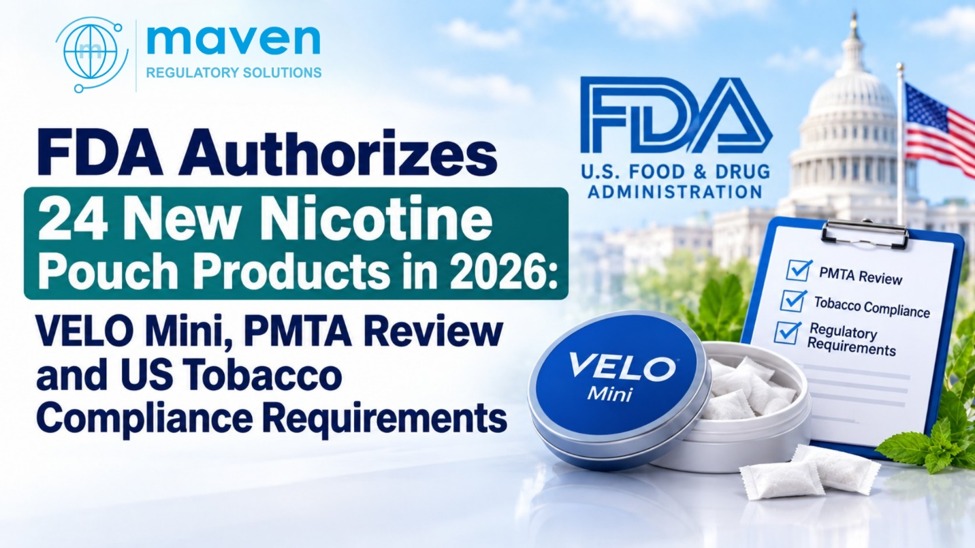
The US Food and Drug Administration (FDA) has authorized the marketing of 24 new nicotine pouch products manufactured by Modoral Brands Inc. under the VELO brand. Announced on 30 October 2026, the authorizations were granted through the Premarket Tobacco Product Application (PMTA) pathway.
The newly authorized products include VELO Mini Pouch and VELO Mini Pouch 2, featuring three packaging configurations and different flavor options. All products contain 4 mg of nicotine and incorporate certified child-resistant packaging.
The FDA's scientific evaluation found that these products contain lower levels of harmful and potentially harmful constituents (HPHCs) compared with cigarettes and smokeless tobacco products. However, marketing authorization does not mean that nicotine pouches are safe or FDA-approved as smoking cessation medicines.
The authorizations also highlight the FDA's efforts to streamline nicotine pouch application reviews through its nicotine pouch pilot programme, improving review efficiency and communication with applicants.
For tobacco manufacturers, nicotine product developers, importers and distributors, this development reinforces the importance of understanding US tobacco product regulations, PMTA requirements, product-specific marketing authorizations and post-market compliance obligations.
Why the FDA's 24 Nicotine Pouch Authorizations Matter
Nicotine pouches are non-combustible tobacco products designed to deliver nicotine through oral use. Their growing presence in the US market has increased regulatory attention on product composition, nicotine exposure, packaging safety, youth access and public health considerations.
The latest FDA authorizations are significant for several reasons:
- Expansion of authorized products: 24 additional VELO nicotine pouch products have received marketing authorization.
- PMTA regulatory pathway: The products underwent FDA scientific evaluation under the established premarket tobacco product application process.
- Product formulation assessment: FDA evaluated nicotine exposure and harmful constituent levels.
- Packaging safety: All three packaging configurations incorporate certified child-resistant features.
- Streamlined regulatory review: The nicotine pouch pilot programme has improved application review efficiency.
- Public health considerations: FDA assessed potential benefits for adults who completely switch from combustible cigarettes alongside risks to youth and non-users.
For businesses, the development demonstrates that product authorization depends on scientific evidence, regulatory submissions and compliance with applicable tobacco control requirements.
What Are the 24 Newly Authorized VELO Nicotine Pouch Products?
On 30 October 2026, FDA authorized 24 products manufactured by Modoral Brands Inc.
The authorization covers eight product and flavors combinations, each available in three packaging configurations, resulting in 24 distinct tobacco products.
Product Categories and Flavors
|
Product Category |
Authorized Flavors |
Nicotine Content |
|
VELO Mini Pouch |
Crema, Lime, Orange Crema, Passion Fruit |
4 mg |
|
VELO Mini Pouch 2 |
Crema, Lime, Orange Crema, Cinnamon |
4 mg |
Each of the eight product variations is available in three authorized packaging configurations.
Key Product and Regulatory Information
|
Regulatory Parameter |
FDA Authorization Details |
|
Manufacturer |
Modoral Brands Inc. |
|
Brand |
VELO |
|
Authorization Date |
30 October 2026 |
|
Total Authorized Products |
24 |
|
Product Variations |
8 |
|
Packaging Configurations |
3 |
|
Nicotine Content |
4 mg per product |
|
Regulatory Pathway |
Premarket Tobacco Product Application (PMTA) |
|
Packaging Safety |
Certified child-resistant packaging |
Packaging was an important element of the FDA's evaluation because it can influence product stability, self-life, moisture characteristics and safety.
Understanding FDA's PMTA Marketing Authorization
The Premarket Tobacco Product Application pathway is an important regulatory requirement under the Family Smoking Prevention and Tobacco Control Act.
Under Section 910 of the Federal Food, Drug, and Cosmetic Act, manufacturers generally cannot legally market a new tobacco product in the United States without obtaining the required FDA marketing authorization or meeting another applicable statutory pathway.
The PMTA process requires manufacturers to provide scientific evidence supporting the marketing of a new tobacco product.
FDA evaluates whether permitting the product to be marketed would be appropriate for the protection of public health.
Key PMTA Assessment Considerations
|
Assessment Area |
Regulatory Consideration |
|
Product Composition |
Ingredients, nicotine content and product characteristics |
|
Toxicological Evaluation |
Harmful and potentially harmful constituents |
|
Manufacturing Information |
Product design, production and quality controls |
|
Public Health Impact |
Risks and benefits to the overall population |
|
Youth Protection |
Potential appeal and accessibility to non-users |
|
Packaging |
Product stability, shelf life and child-resistant features |
|
Scientific Evidence |
Supporting studies and relevant research data |
A marketing order granted is product specific. Manufacturers should not assume that authorization for one formulation, flavors or packaging configuration automatically covers other product variations.
FDA Nicotine Pouch Pilot Programme: Improving Regulatory Review
The latest VELO authorizations were reviewed under FDA's nicotine pouch pilot programme.
The programme was introduced to improve the efficiency of PMTA reviews for nicotine pouch products while maintaining the agency's scientific and public health assessment requirements.
According to FDA, the programme has helped achieve:
- Faster resolution of scientific and regulatory issues.
- Reduced applicant response times for deficiency letters.
- More efficient scientific reviews.
- Improved application review processes.
- Greater consistency in addressing regulatory deficiencies.
The programme does not eliminate the PMTA requirement or guarantee marketing authorization.
Manufacturers must continue providing adequate scientific evidence demonstrating that their products meet the applicable public health standard.
Harmful and Potentially Harmful Constituents: Regulatory Significance
FDA's evaluation found that the 24 VELO products contained lower levels of HPHCs compared with cigarettes and smokeless tobacco products.
Several carcinogenic HPHCs were not measurable in the newly authorized products.
However, lower constituent levels should not be interpreted as evidence that nicotine pouches are harmless.
Nicotine is addictive, and all tobacco products carry health risks. FDA's public health assessment considers the overall population, including potential benefits for adults who switch completely from other tobacco products and risks to youth and individuals who do not currently use tobacco.
Importantly, dual use of nicotine pouches and combustible cigarettes does not provide the same degree of potential health benefit as completely switching away from combustible products.
Who Should Pay Attention to the New FDA Authorizations?
The development is relevant to businesses operating across the tobacco and nicotine product supply chain.
|
Business / Stakeholder |
Key Regulatory Consideration |
|
Nicotine pouch manufacturers |
PMTA submissions and product-specific authorization |
|
Tobacco brand owners |
Brand and product marketing compliance |
|
Ingredient suppliers |
Ingredient specifications and safety documentation |
|
Contract manufacturers |
Manufacturing controls and product consistency |
|
Importers |
Verification of applicable US marketing authorization |
|
Distributors |
Authorized product sourcing and distribution |
|
Retailers |
Verification of lawful product listings and age restrictions |
|
Packaging suppliers |
Child-resistant packaging and product safety |
|
Regulatory affairs teams |
FDA submissions and regulatory monitoring |
US Nicotine Pouch Compliance: Industry Readiness Checklist
Businesses planning to manufacture, import or distribute nicotine pouch products in the United States should establish appropriate regulatory controls.
|
Compliance Area |
Recommended Action |
|
Product Authorization |
Verify applicable FDA marketing orders |
|
PMTA Documentation |
Maintain supporting application records |
|
Product Composition |
Document nicotine content and ingredients |
|
Toxicological Assessment |
Evaluate relevant HPHCs |
|
Packaging Compliance |
Assess child-resistant packaging requirements |
|
Product Labelling |
Review applicable tobacco product labelling requirements |
|
Manufacturing Controls |
Maintain product quality and consistency |
|
Supply Chain |
Qualify suppliers and verify specifications |
|
Distribution |
Confirm product-specific marketing authorization |
|
Post-Market Compliance |
Monitor FDA regulatory developments and enforcement |
Companies should also distinguish FDA marketing authorization from modified-risk tobacco product authorization and authorization of smoking cessation medicines. These are separate regulatory concepts with different requirements.
Regulatory Implications for Manufacturers and Importers
The latest authorizations demonstrate the importance of developing a comprehensive US tobacco regulatory strategy.
Manufacturers should focus on:
- Establishing appropriate PMTA submission strategies.
- Generating product-specific scientific evidence.
- Evaluating nicotine exposure and toxicological risks.
- Maintaining consistent manufacturing specifications.
- Assessing packaging safety and product stability.
- Reviewing product labelling and marketing claims.
- Maintaining regulatory documentation.
Importers and distributors should verify that products have the required FDA marketing authorization before entering the US market.
FDA's authorized nicotine pouch product list is an important reference for checking which products may legally be marketed in the United States.
As of 30 October 2026, FDA reported a total of 67 authorized nicotine pouch products.
Frequently Asked Questions
1. What did FDA authorize on 30 October 2026?
FDA authorized 24 new VELO nicotine pouch products manufactured by Modoral Brands Inc. through the PMTA pathway.
2. Which VELO products received authorization?
VELO Mini Pouch and VELO Mini Pouch 2 received authorization across three packaging configurations.
3. What is the nicotine strength of the newly authorized products?
All 24 products contain 4 mg of nicotine.
4. Which flavors are included?
VELO Mini Pouch includes Crema, Lime, Orange Crema and Passion Fruit. VELO Mini Pouch 2 includes Crema, Lime, Orange Crema and Cinnamon.
5. Are the products FDA-approved?
No. They received FDA marketing authorization. This does not mean they are FDA-approved as safe products or smoking cessation medicines.
6. What is the PMTA pathway?
PMTA is the premarket tobacco product application pathway through which manufacturers submit scientific and product information for FDA review before marketing a new tobacco product.
7. What is the FDA nicotine pouch pilot programme?
It is an initiative designed to improve the efficiency of nicotine pouch PMTA reviews while retaining scientific and public health assessments.
8. Are the newly authorized nicotine pouches risk-free?
No. Nicotine is addictive, and all tobacco products carry health risks. Lower HPHC levels do not mean that nicotine pouches are harmless.
9. Why is child-resistant packaging important?
It helps reduce the risk of accidental nicotine exposure and poisoning among young children.
10. Can other nicotine pouch products be marketed based on these authorizations?
No. FDA marketing authorizations are product specific. Other products must independently satisfy applicable regulatory requirements.
Conclusion
FDA's authorization of 24 new VELO nicotine pouch products on 30 October 2026 represents an important development in the US tobacco regulatory landscape.
The decision highlights the importance of scientific evidence, product-specific PMTA authorization, toxicological assessment, packaging safety and public health considerations.
The FDA's nicotine pouch pilot programme also demonstrates opportunities to improve regulatory review efficiency without eliminating the underlying scientific assessment requirements.
For manufacturers, importers, suppliers and distributors, maintaining product authorization records, appropriate quality controls, compliant labelling and effective post-market monitoring remain essential.
Businesses should proactively monitor FDA tobacco regulations and ensure that every product intended for the US market meets the applicable marketing authorization and compliance requirements.
How Maven Regulatory Solutions Can Help
Maven Regulatory Solutions supports businesses with regulatory and scientific compliance services, including:
- US FDA tobacco product regulatory assessments.
- PMTA regulatory strategy and submission support.
- Nicotine product regulatory applicability assessments.
- Product formulation and ingredient assessments.
- Toxicological risk assessments.
- HPHC evaluation and scientific documentation support.
- Product labelling and regulatory reviews.
- Packaging compliance assessments.
- Regulatory gap assessments.
- Product lifecycle management.
- Regulatory intelligence and monitoring.
- Global regulatory compliance support.
Our approach helps businesses understand evolving regulatory requirements, evaluate product compliance risks and strengthen their regulatory strategies for global market access.
Maven Regulatory Solutions
Science. Compliance. Impact.

Post a comment