
July 09, 2026
How Digital Labeling, Structured Content, ePI, CCDS Governance, and Regulatory Intelligence Are Transforming Pharmaceutical Product Information Management
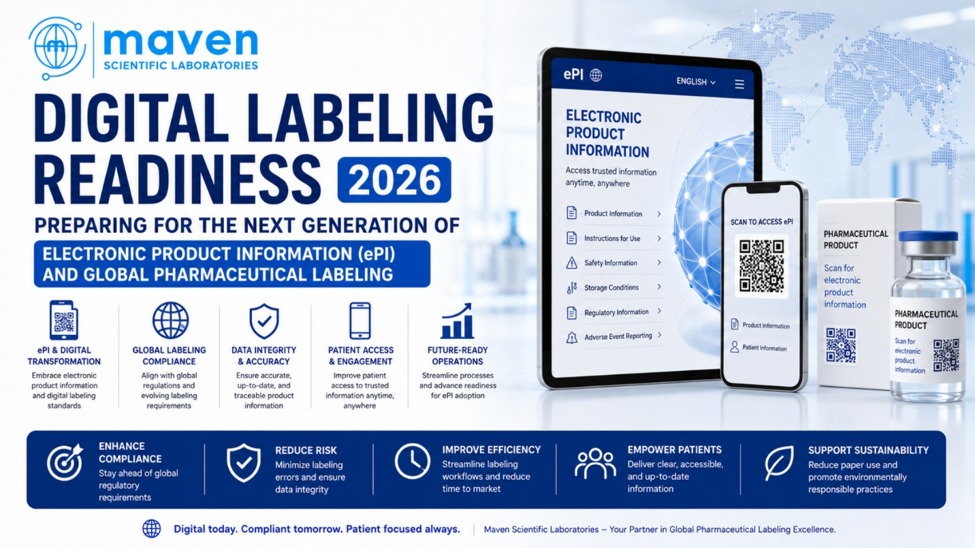
Digital labeling enables pharmaceutical companies to create, manage, and distribute approved product information using structured electronic content. As global regulators advance Electronic Product Information (ePI), organizations should strengthen structured content management, Company Core Data Sheet (CCDS) governance, digital workflows, and regulatory intelligence to improve compliance, accelerate labeling updates, and support future digital healthcare ecosystems.
Why Digital Labeling Is Becoming a Strategic Priority
Pharmaceutical labeling evolves from paper-based documents to structured digital content. While printed package inserts remain mandatory in many markets, regulators increasingly support Electronic Product Information (ePI) to improve accessibility, consistency, and lifecycle management.
Healthcare professionals and patients expect accurate, up-to-date digital product information, while regulators seek faster implementation of approved safety updates.
Without a digital labeling strategy, organizations may face:
- Delayed labeling updates
- Inconsistent global product information
- Manual review and document management
- Higher operational costs
- Labeling discrepancies
- Limited content reuse
- Inefficient change management
- Reduced inspection readiness
Digital labeling is now a strategic capability that improves compliance, operational efficiency, and global consistency.
Executive Overview
Digital labeling is transforming Regulatory Affairs by enabling structured management of approved product information throughout its lifecycle.
A future-ready program should be:
- Regulatory complaint
- Patient-centric
- Digitally enabled
- Structured and standardized
- Globally aligned
- Lifecycle managed
- Inspection ready
- Scalable
- Governed through strong CCDS management
- Supported by regulatory intelligence
Organizations adopting these capabilities improve efficiency while maintaining compliance across markets.
From Paper-Based Labeling to Digital Product Information
Traditional labeling depends on printed package inserts, prescribing information, carton text, and patient leaflets. Every approved safety update or manufacturing change often requires revisions across multiple markets.
Digital labeling manages approved information as structured electronic content, enabling faster updates and easier distribution.
Key Benefits
- Faster implementation of approved changes
- Better accessibility
- Improved searchability
- Reduced dependence on paper
- Integration with healthcare systems
- Greater global consistency
- Efficient lifecycle management
- Better multilingual support
What Is Digital Labeling Readiness?
Digital labeling readiness is an organization's ability to create, manage, govern, and distribute structured electronic product information while remaining compliant with global regulations.
Core capabilities include:
- Electronic Product Information (ePI)
- Structured content management
- CCDS governance
- Labeling lifecycle management
- Regulatory intelligence
- Digital approval workflows
- Content reuse
- Change control
- Global labeling harmonization
- Data standardization
Traditional Labeling vs. Digital Labeling
| Traditional Labeling | Digital Labeling |
| Paper documents | Structured electronic content |
| Manual updates | Automated workflows |
| Multiple document versions | Centralized content |
| Limited search | Searchable information |
| Slow implementation | Faster updates |
| Higher printing costs | Reduced paper usage |
| Market duplication | Content reuse |
Key Drivers Accelerating Digital Labeling
1. Regulatory Modernization
Health authorities are increasingly supporting Electronic Product Information (ePI), enabling faster implementation of approved labeling updates.
2. Global Harmonization
Structured digital content improves consistency across markets, simplifies submissions, and reduces duplication.
3. Faster Safety Communication
Digital labeling allows healthcare professionals and patients to access approved safety updates more quickly.
4. Expansion of Digital Health
Structured product information supports integration with:
- Electronic Health Records (EHRs)
- Clinical Decision Support Systems (CDSS)
- Mobile health applications
- Telemedicine
- Digital patient engagement tools
5. Sustainability
Digital labeling supports ESG initiatives by:
- Reducing paper consumption
- Lowering printing needs
- Improving document lifecycle efficiency
- Supporting environmentally responsible operations
Key Drivers of Digital Labeling Transformation
| Industry Driver | Business Impact |
| Regulatory modernization | Improved compliance |
| Electronic Product Information (ePI) | Faster information access |
| Global harmonization | Greater consistency |
| Pharmacovigilance | Faster safety updates |
| Digital healthcare | Better interoperability |
| Sustainability | Less paper documentation |
Why Structured Content Is the Foundation
Many companies still manage labeling through Word documents, PDFs, and spreadsheets, creating duplication and inconsistency.
Structured content organizes approved information into reusable components that can be centrally updated and reused across products and markets.
Benefits
- Content reuse
- Better version control
- Reduced duplication
- Faster updates
- Global consistency
- Multilingual support
- Automated publishing
Benefits of Structured Content Management
| Capability | Business Benefit |
| Content reuse | Less duplication |
| Standardized content | Greater consistency |
| Version control | Better governance |
| Digital workflows | Faster updates |
| Central repository | Single source of truth |
| Traceability | Stronger compliance |
| Lifecycle management | Higher efficiency |
Building a Digital-First Labeling Strategy
Digital labeling should be treated as a long-term business transformation.
Successful strategies include:
- Single source of truth
- Strong CCDS governance
- Structured content models
- Digital approval workflows
- Cross-functional collaboration
- Regulatory intelligence
- Lifecycle governance
- Inspection-ready documentation
Assessing Digital Labeling Readiness
1. Content Structure
Evaluate whether:
- Content is standardized
- Information is reusable
- Duplication is minimized
- Content is centrally managed
- Terminology is consistent
2. CCDS Governance
Review:
- CCDS ownership
- Approval workflows
- Version control
- Change management
- Cross-functional review
- Global responsibilities
3. Technology Infrastructure
Assess support for:
- Structured content
- ePI
- Digital workflows
- Regulatory document management
- RIM integration
- Cloud collaboration
- Audit trails
- Electronic records
4. Regulatory Compliance
Review:
- Labeling reviews
- Submission workflows
- Change management
- Inspection readiness
- Health authority communication
- Regulatory intelligence
5. Global Labeling Strategy
Include:
- Centralized CCDS
- Harmonized policies
- Regional adaptation
- Standard timelines
- Governance committees
Digital Labeling Readiness Assessment
| Assessment Area | Objective |
| Structured Content | Improve consistency |
| CCDS Governance | Global alignment |
| Technology | Enable digital workflows |
| Regulatory Processes | Maintain compliance |
| Global Strategy | Balance harmonization |
| Change Management | Faster updates |
Best Practices
Establish a Single Source of Truth
Improve:
- Consistency
- Traceability
- Version control
- Global updates
Strengthen CCDS Governance
Focus on:
- Regular reviews
- Scientific consistency
- Approval workflows
- Version management
- Market impact assessments
Implement Structured Content
Enable:
- Content reuse
- Automated publishing
- Faster translations
- Efficient submissions
- Global consistency
Promote Cross-Functional Collaboration
Involve:
- Regulatory Affairs
- Medical Affairs
- Pharmacovigilance
- Quality Assurance
- IT
- Manufacturing
- Supply Chain
- Commercial teams
Strengthening Regulatory Intelligence
Monitor:
- ePI initiatives
- Regional guidance
- Digital health regulations
- Harmonization efforts
- Data standards
- Consultation papers
Common Challenges
Organizations commonly face:
- Legacy systems
- Fragmented processes
- Inconsistent global content
- Limited structured content
- Regional differences
- Resource constraints
- Resistance to change
- Data standardization issues
- Multiple content owners
- Complex approval workflows
Common Mistakes
Avoid:
- Delaying digital transformation
- Managing content in multiple systems
- Weak change control
- Limited cross-functional engagement
- Ignoring future regulatory trends
Digital Labeling Implementation Roadmap
| Activity | Frequency | Benefit |
| Review strategy | Annually | Greater consistency |
| Update CCDS | Ongoing | Better alignment |
| Monitor ePI | Monthly | Regulatory readiness |
| Review content | Quarterly | Higher quality |
| Train teams | Annually | Stronger collaboration |
| Assess technology | Periodically | Transformation readiness |
Future Trends
Emerging developments include:
- Electronic Product Information (ePI)
- AI-assisted labeling
- XML-based structured content
- Digital first submissions
- Cloud labeling platforms
- Automated publishing
- Global interoperability
- EHR integration
- QR code-enabled information
- Patient-centric communication
- Multilingual delivery
- Enhanced cybersecurity
Business Benefits
| Business Function | Key Benefit |
| Regulatory Affairs | Faster labeling updates |
| Medical Affairs | Scientific consistency |
| Quality Assurance | Better traceability |
| Manufacturing | Fewer packaging delays |
| Market Access | Faster launches |
| Executive Leadership | Lower compliance risk |
Frequently Asked Questions
1. What is digital labeling?
Structured electronic management and distribution of pharmaceutical product information.
2. What is ePI?
Electronic Product Information is a structured digital format for approved medicinal product information.
3. Why is digital labeling important?
It improves compliance, efficiency, accessibility, and lifecycle management.
4. What is CCDS?
The Company Core Data Sheet serves as the global reference for consistent product information.
5. Will digital labeling replace printed inserts?
Not entirely. Many regulators still require printed labeling while adopting hybrid approaches.
6. What is structured content management?
Managing reusable content components to improve consistency, traceability, and version control.
7. How can companies prepare?
- Strengthening CCDS governance
- Standardized content
- Implement structured content
- Modernized workflows
- Monitor regulations
- Encourage collaboration
8. What are the biggest challenges?
- Legacy systems
- Fragmented repositories
- Regional differences
- Weak governance
- Limited structured content
- Change management
9. How does digital labeling improve compliance?
It enhances consistency, audit trails, lifecycle management, submissions, and approved labeling updates.
10. How can Maven Regulatory Solutions help?
Maven supports:
- Digital labeling strategy
- ePI readiness
- CCDS governance
- Structured content management
- Global labeling lifecycle management
- Regulatory intelligence
- Gap assessments
- Regulatory documentation
- Process optimization
- Global labeling harmonization
Conclusion
Digital labeling is becoming a core element of pharmaceutical Regulatory Affairs. As regulators advance Electronic Product Information (ePI) and structured content standards, organizations should move from document-centric processes to digital-first labeling models.
Strengthening structured content, CCDS governance, regulatory intelligence, lifecycle management, and digital workflows improve compliance, accelerate approved labeling updates, enhance global consistency, and prepare organizations for the future of digital healthcare.
Why Choose Maven Regulatory Solutions?
Maven Regulatory Solutions helps pharmaceutical companies modernize labeling through digital labeling readiness assessments, structured content implementation, CCDS governance, regulatory intelligence, and global labeling lifecycle management. Our compliance-focused approach enables organizations to build scalable, efficient, and future-ready labeling programs while maintaining global regulatory compliance.

Post a comment