
December 06, 2025
Why Growing Non-Compliance In CE-Marked Electrical Products Is Raising Major EU Safety Concerns
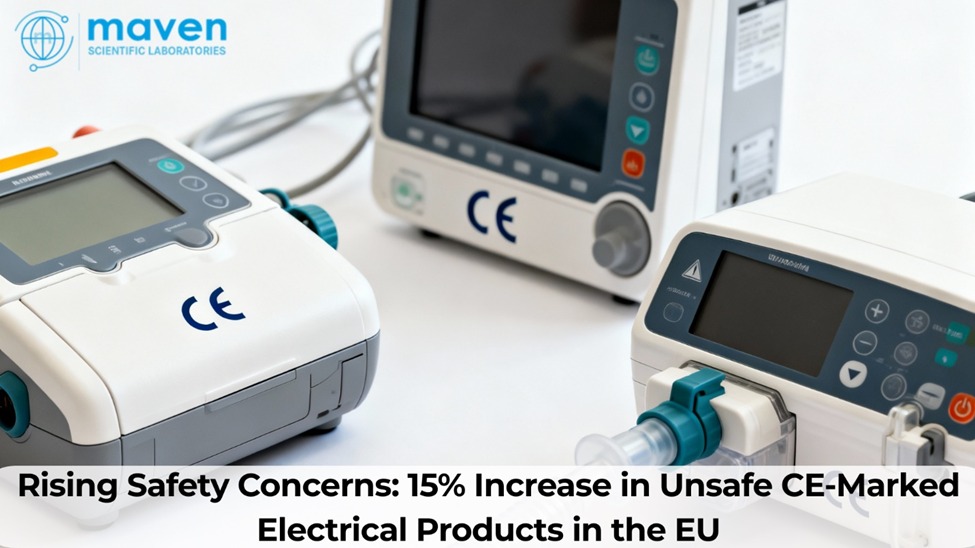
A recent European Union market surveillance study has revealed a concerning rise in unsafe CE-marked electrical products, highlighting significant gaps in product safety compliance, market surveillance, and manufacturer quality controls across the EU.
The findings show a:
15% increase in non-compliant CE-marked electrical products since 2017
raising serious concerns about:
- Consumer safety
- Electrical fire hazards
- Electric shock risks
- Inadequate conformity assessment procedures
- Weak third-party testing practices
At Maven Regulatory Solutions, we help manufacturers, importers, and distributors strengthen EU product compliance, ensure proper CE marking, and maintain alignment with evolving European regulatory frameworks.
Understanding The EU Product Safety Study (2022)
In 2022, European market surveillance authorities conducted a major safety assessment involving:
120 CE-marked household electrical products
The products were purchased from multiple EU markets and online platforms for independent laboratory testing.
Products Included in the Study
The assessment covered common consumer electrical products, including:
- Battery chargers
- Hair dryers
- Hair straighteners
- Space heaters
- Toasters
- Grills
- Electric irons
- Fans
- Luminaires and lighting equipment
Testing Standards Used
Products were tested against European harmonized safety standards under:
Low Voltage Directive 2014/35/EU
Testing included compliance with:
- EN 60335 series for household appliances
- EN 60598 for luminaires and lighting equipment
All evaluations were conducted in accredited independent laboratories.
Key Findings from the EU Safety Study
The study identified alarming levels of non-compliance.
Major Compliance Statistics
| Compliance Finding | Result |
| Total products tested | 120 |
| Non-compliant products | 85 |
| Products with critical safety risks | 28 |
| Increase in non-compliance since 2017 | 15% |
| Dangerous product rate increase | From 17% to 23% |
Critical Risks Identified
The unsafe products presented risks including:
- Electric shock hazards
- Fire risks
- Overheating
- Electrical insulation failures
- Poor wiring protection
- Mechanical safety failures
Many products posed direct threats to consumer safety.
Why CE Marking Alone Is Not Enough
A key conclusion from the study is that:
CE marking alone does not guarantee product safety
Many manufacturers relied solely on:
- Self-declaration systems
- Internal conformity assessments
- Incomplete technical documentation
without performing:
- Independent laboratory testing
- Robust risk assessments
- Ongoing compliance verification
Understanding The EU CE Marking System
Under EU regulations, many electrical products can be CE-marked through:
Manufacturer self-certification
This means manufacturers declare compliance without mandatory third-party certification in many cases.
While this system supports market efficiency, it can create compliance risks when:
- Testing is insufficient
- Documentation is incomplete
- Product design changes are unmanaged
- Imported products bypass proper controls
EU Safety Gate & RAPEX 2022 Findings
The European Commission Safety Gate system (formerly RAPEX) recorded:
2,117 product safety alerts in 2022
equivalent to approximately:
50 safety notifications per day
Main Product Risk Categories
| Risk Category | Percentage |
| Chemical hazards | 35% |
| Injuries | 25% |
| Choking hazards | 14% |
| Electric shock | 9% |
| Fire hazards | 9% |
| Other risks | 8% |
Electrical Products Remain High Risk
Electrical appliances and equipment represented:
8% of all EU safety alerts
demonstrating the growing regulatory focus on:
- Electrical safety
- Consumer protection
- Product traceability
- Online marketplace surveillance
Digital Enforcement: EU E-Surveillance Web Crawler
To strengthen market surveillance, the European Commission launched the:
E-Surveillance Web Crawler
in April 2022.
This AI-powered enforcement tool automatically identifies:
- Unsafe products online
- Banned product listings
- Non-compliant marketplace sellers
Why Digital Surveillance Matters
The rapid growth of e-commerce has increased the availability of:
- Low-cost imported products
- Unverified CE-marked goods
- Counterfeit electrical devices
Digital enforcement tools help regulators:
- Track unsafe products faster
- Remove dangerous listings
- Improve online consumer safety
- Strengthen cross-border enforcement
Why Non-Compliance Is Increasing Across The EU
Several major factors are contributing to the increase in unsafe electrical products.
1. Weak Self-Certification Practices
Many manufacturers rely on:
- Incomplete testing
- Minimal documentation
- Generic declarations of conformity
without sufficient product validation.
2. Lack Of Third-Party Testing
Independent product testing is often limited due to:
- Cost pressures
- Faster product launch timelines
- Importer oversight gaps
This significantly increases compliance risks.
3. Rapid Growth of Online Imports
Online marketplaces have accelerated sales of:
- Cheap imported electrical products
- Non-traceable manufacturers
- Products passing traditional distribution channels
4. Inconsistent EU Market Surveillance
Enforcement levels may vary between EU member states, creating uneven compliance oversight across markets.
Key EU Regulations Affecting Electrical Products
Manufacturers and importers must comply with multiple EU directives and regulations.
| EU Regulation / Directive | Purpose |
| Low Voltage Directive (LVD) | Electrical safety requirements |
| EMC Directive | Electromagnetic compatibility |
| RoHS Directive | Restriction of hazardous substances |
| General Product Safety Regulation (GPSR) | Consumer product safety |
| CE Marking Requirements | Market conformity declaration |
Business Risks of Non-Compliance
Failure to comply with EU product safety requirements can result in:
- Product recalls
- Customs detentions
- Market bans
- Financial penalties
- Legal liabilities
- Reputational damage
For global brands, regulatory failures can significantly impact consumer trust and market access.
How Maven Regulatory Solutions Supports EU Compliance
At Maven Regulatory Solutions, we help companies simplify complex EU product compliance requirements.
Our Services
Regulatory Strategy & Risk Assessment
We identify:
- Applicable directives
- Harmonized standards
- Product risk categories
- Required Conformity Routes
Technical Documentation Review
We support preparation and review of:
- Technical files
- CE marking dossiers
- Risk assessments
- EU Declarations of Conformity (DoC)
Third-Party Testing Coordination
We coordinate testing through accredited laboratories for:
- Electrical safety
- EMC testing
- Product performance validation
Compliance Consulting & Regulatory Support
Our experts assist with:
- CE marking compliance
- Market access strategies
- Regulatory submissions
- Import/export readiness
Why Choose Maven
- Expertise in EU product regulations
- Strong global compliance capabilities
- End-to-end regulatory consulting
- Faster market access support
- Risk-based compliance strategies
Emerging Product Safety Trends In 2025
AI-Driven Market Surveillance
Regulators increasingly use:
- AI-based product monitoring
- Automated compliance screening
- Digital product traceability tools
Stronger Import Controls
EU authorities are implementing:
- Enhanced customs inspections
- Digital product passport initiatives
- Increased online marketplace accountability
Greater Focus on Consumer Protection
Future EU regulations are expected to strengthen:
- Product traceability
- Technical documentation requirements
- Importer accountability
- Continuous compliance obligations
Quick Highlights
- EU study found a 15% rise in unsafe CE-marked products
- 85 out of 120 tested products were non-compliant
- Critical risks included electric shock and fire hazards
- CE marking alone does not guarantee safety
- Independent testing and documentation are increasingly important
- EU regulators are strengthening digital market surveillance
- Online marketplaces remain a major compliance challenge
Conclusion
The increase in unsafe CE-marked electrical products across the European Union highlights a growing need for:
- Stronger conformity assessments
- Independent testing
- Better technical documentation
- Enhanced market surveillance
- Proactive regulatory compliance strategies
As regulatory scrutiny intensifies in 2025 and beyond, manufacturers and importers must move beyond simple CE declarations and adopt comprehensive compliance frameworks that prioritize:
- Consumer safety
- Product reliability
- Regulatory transparency
- Long-term market trust
At Maven Regulatory Solutions, we help organizations navigate evolving EU regulations with confidence ensuring products entering the European market are safe, compliant, and ready.
FAQs
1. What did the EU safety study find?
The study found a 15% increase in unsafe CE-marked electrical products compared to 2017.
2. What types of products were tested?
Battery chargers, hair dryers, heaters, luminaires, toasters, and other household electrical products.
3. What are the main risks identified?
Electric shock, fire hazards, overheating, and insulation failures.
4. Does CE marking guarantee product safety?
No. CE marking alone does not guarantee safety if testing and documentation are insufficient.
5. What is the Low Voltage Directive?
The LVD establishes electrical safety requirements for products sold in the EU.
6. Why are unsafe products increasing?
Due to weak self-certification, limited testing, online imports, and inconsistent enforcement.
7. How can Maven help with CE compliance?
Maven supports CE marking, technical documentation, testing coordination, and EU regulatory compliance strategies.

Post a comment