
July 11, 2026
A Complete Guide to OSHA HCS, EU CLP, REACH, SDS Compliance, Hazard Communication, Inspection Readiness, and Product Claims Substantiation
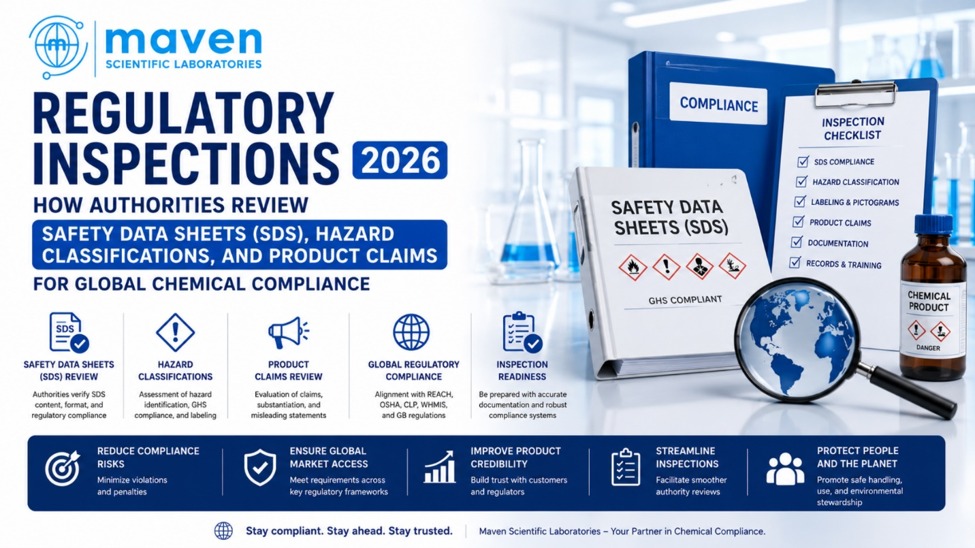
Regulatory inspections in 2026 have become more comprehensive, with authorities reviewing not only Safety Data Sheets (SDSs) but also hazard classifications, product labels, technical documentation, supplier data, and marketing claims. Organizations complying with OSHA Hazard Communication Standard (HCS), EU CLP Regulation, REACH, and other global chemical regulations are expected to maintain scientifically justified hazard classifications, consistent documentation, compliant labeling, and substantiated product claims. Proactive SDS management and inspection readiness help reduce compliance risks, avoid enforcement actions, and support global market access.
Why Regulatory Inspections Are Becoming More Intensive
Chemical regulations continue to evolve, increasing expectations for scientific justification, transparency, and documentation accuracy.
Today's inspections evaluate the complete chemical compliance lifecycle from hazard classification and supplier information to labeling, employee training, technical documentation, and marketing claims.
Inspectors increasingly ask one question:
Can the company scientifically justify every hazard classification, SDS statement, label element, and product claim?
Without a proactive inspection readiness strategy, organizations may face:
- Regulatory observations
- Warning letters
- Product recalls
- Market access restrictions
- SDS revision requests
- Product claim investigations
- Financial penalties
- Increased customer audits
- Supply chain disruptions
- Reputational damage
Inspection readiness is now a strategic compliance function rather than a periodic audit activity.
Why SDS Compliance Is Receiving Greater Regulatory Attention
Safety Data Sheets remain the primary hazard communication document across the supply chain.
Authorities expect SDS information to be accurate, current, scientifically supported, and consistent with all related documentation.
Modern inspections commonly compare:
- Safety Data Sheets
- Product labels
- Technical Data Sheets (TDS)
- Product specifications
- Regulatory notifications
- Poison Centre Notifications (PCN)
- Marketing brochures
- Company websites
- Sustainability reports
- Advertising materials
Any inconsistency can trigger expanded regulatory review.
What Authorities Review During SDS Inspections
Regulators assess whether Hazard Communication Programs demonstrate scientific credibility, consistency, and effective document governance.
Core Areas Reviewed During Regulatory Inspections
| Inspection Area | Primary Regulatory Focus |
| Hazard Classification | Scientific accuracy and methodology |
| Safety Data Sheets | Completeness and consistency |
| Product Labels | Correct hazard communication |
| Product Claims | Scientific substantiation |
Rather than reviewing documents individually, inspectors evaluate how well they align across the compliance system.
Hazard Classification: The Foundation of Compliance
Authorities expect every hazard classification to be supported by documented scientific evidence.
Typical inspection reviews include:
- Classification methodology
- Scientific literature
- Experimental data
- Weight of Evidence (WoE)
- Read-across assessments
- Bridging principles
- Supplier information
- Expert toxicological reviews
- Classification records
- Internal approval procedures
Inspectors also verify alignment with the latest OSHA HCS, EU CLP, and other applicable regulations.
New Hazard Classes Increasing Inspection Complexity
Recent EU CLP updates require evaluation of additional hazard categories, including:
- Endocrine Disruptors (ED)
- Persistent, Bioaccumulative and Toxic (PBT)
- Very Persistent and Very Bioaccumulative (vPvB)
- Persistent, Mobile and Toxic (PMT)
- Very Persistent and Very Mobile (vPvM)
These classifications require robust toxicological, ecotoxicological, and environmental evidence supported by current scientific literature.
Scientific Evidence Commonly Requested
| Documentation | Regulatory Purpose |
| Toxicological studies | Human health classifications |
| Ecotoxicological data | Environmental assessments |
| Read-across justifications | Classification support |
| Scientific literature | Hazard validation |
| Supplier SDS validation | Upstream data verification |
| Weight of Evidence | Scientific decision-making |
SDS Sections Receiving the Greatest Regulatory Attention
Section 2 – Hazard Identification
Authorities verify:
- Hazard classifications
- Hazard categories
- Signal words
- H-statements
- P-statements
- GHS/CLP pictograms
- Supplemental information
Section 2 is routinely compared with product labels for consistency.
Section 3 – Composition
Inspectors’ assessment:
- Ingredient identities
- Concentration ranges
- Hazardous constituents
- UFI consistency (where applicable)
- Confidential business information
- Supplier formulation records
Section 11 – Toxicological Information
Authorities review whether:
- Health effects are accurate
- Exposure routes are complete
- Toxicological endpoints are supported
- Data sources are current
- Hazard conclusions match scientific evidence
Section 12 – Ecological Information
Inspectors evaluate:
- Environmental classifications
- Persistence
- Bioaccumulation
- Mobility
- PBT/vPvB conclusions
- PMT/vPvM assessments
Environmental claims should remain consistent with Section 12.
SDS Sections Most Frequently Reviewed
| SDS Section | Inspection Focus |
| Section 2 | Hazard Identification |
| Section 3 | Ingredient Composition |
| Section 8 | Exposure Controls & PPE |
| Section 11 | Toxicology |
| Section 12 | Ecology |
| Section 14 | Transport |
| Section 15 | Regulatory Information |
How Authorities Review Product Claims
Inspections now extend beyond SDSs to all public-facing communications.
Authorities review:
- Company websites
- Product brochures
- Catalogs
- Product labels
- Technical Data Sheets
- Sales presentations
- Digital marketing
- Sustainability reports
- Social media
- Product packaging
Claims such as:
- "Non-toxic"
- "Safe for people"
- "Eco-friendly"
- "Environmentally safe"
- "Green chemistry"
- "Non-hazardous"
must be scientifically substantiated and must not contradict SDS classifications or product labels.
Organizations should establish cross-functional review involving Regulatory Affairs, Product Stewardship, EHS, Legal, and Marketing before publishing product claims.
Common Inspection Findings
The most frequent observations include:
1. Outdated Safety Data Sheets
Examples include:
- Obsolete hazard classifications
- Missing new hazard classes
- Outdated supplier information
- Withdrawn regulatory references
- Outdated toxicological or ecotoxicological data
- Misalignment with current OSHA HCS or EU CLP requirements
2. Inconsistent Documentation
Common examples:
- SDSs differing from labels
- Inconsistent hazard statements
- Unsupported Technical Data Sheet claims
- Supplier SDS conflicts
- Marketing inconsistencies
- PCN discrepancies
3. Weak Scientific Justification
Authorities commonly request:
- Toxicological assessments
- Ecotoxicological studies
- Weight of Evidence evaluations
- Read-across documentation
- Literature reviews
- Expert opinions
- Internal classification reports
4. Poor Document Control
Inspectors review:
- Version control
- Document approvals
- Revision history
- Change management
- Supplier updates
- SDS distribution
- Record retention
- Periodic reviews
5. Inadequate Employee Training
Training records typically include:
- Hazard Communication
- SDS accessibility
- Workplace labeling
- Safe chemical handling
- Emergency response
- PPE requirements
Most Common Inspection Findings
| Finding | Potential Impact |
| Outdated SDS | Corrective actions |
| Inconsistent documentation | Expanded inspections |
| Unsupported classifications | Additional scientific evidence |
| Weak document control | Quality deficiencies |
| Inadequate training | OSHA HCS non-compliance |
| Unsupported product claims | Marketing enforcement |
Why Inspection Risks Continue to Increase
Key drivers include:
Expansion of Hazard Classes
- Endocrine Disruptors (ED)
- PBT
- vPvB
- PMT
- vPvM
Increased Transparency Expectations
Authorities increasingly expect documentation:
- Scientific decision-making
- Classification methodology
- Source data
- Expert review
- Internal approvals
Greater Enforcement Activity
Inspection programs now include:
- Targeted inspections
- Random audits
- Market surveillance
- Import inspections
- Supply chain verification
- Follow-up inspections
- Complaint-driven investigations
Increased Scrutiny of Sustainability Claims
Claims such as:
- Eco-friendly
- Green
- Sustainable
- Environmentally safe
- Non-toxic
- Biodegradable
must be scientifically supported and aligned with SDS classifications.
Best Practices for Inspection Readiness
Conduct Routine Internal SDS Audits
Review:
- Hazard classifications
- SDS sections
- Label consistency
- Scientific evidence
- Product claims
- Supplier documentation
Validate Supplier Information
Verify:
- Hazard classifications
- Ingredient information
- Scientific updates
- Regulatory changes
- SDS revisions
Establish Product Claim Reviews
Evaluate before publication:
- Website content
- Brochures
- Catalogs
- Social media
- Sustainability reports
- Technical Data Sheets
- Sales presentations
Strengthening Documentation Governance
Implement:
- Centralized SDS management
- Version control
- Change management
- Scientific justification files
- Audit trails
- Supplier communication records
- Approval workflows
Train Cross-Functional Teams
Include:
- Regulatory Affairs
- Environmental Health & Safety (EHS)
- Product Stewardship
- Quality Assurance
- R&D
- Manufacturing
- Marketing
- Supply Chain
- Customer Support
Regulatory Inspection Readiness Checklist
| Activity | Frequency | Business Benefit |
| Review SDS accuracy | Every regulatory update | Improved compliance |
| Verify hazard classifications | Periodically | Fewer inspection findings |
| Audit product claims | Before publication | Lower enforcement risk |
| Update supplier information | Ongoing | Better data quality |
| Train employees | Annually or after major changes | Stronger Hazard Communication |
| Review document control | Quarterly | Better inspection readiness |
Future Trends
Emerging developments include:
- Digital SDS management
- AI-assisted hazard classification
- Product claims substantiation
- Green claims verification
- Global GHS harmonization
- Real-time regulatory intelligence
- Integrated compliance systems
- Lifecycle chemical compliance
Business Benefits
| Business Area | Benefit |
| Regulatory Affairs | Faster inspection response |
| Quality Assurance | Better document control |
| EHS | Improved workplace safety |
| Marketing | Lower claims risk |
| Supply Chain | Better supplier compliance |
| Executive Management | Reduced regulatory risk |
Frequently Asked Questions
1. What do inspectors review?
Hazard classifications, SDSs, labels, scientific evidence, document control, employee training, and product claims.
2. Why is hazard classification important?
It forms the basis for SDSs, labels, workplace hazard communication, and regulatory notifications.
3. Which SDS sections receive the most attention?
Sections 2, 3, 11, and 12, along with Sections 8, 14, and 15.
4. Are marketing claims reviewed?
Yes. Authorities compare websites, labels, brochures, and technical documents with SDS information.
5. Common inspection findings?
Outdated SDSs, inconsistent documentation, unsupported classifications, weak document control, and inadequate training.
6. Why are inspections becoming more rigorous?
New hazard classes, evolving regulations, sustainability expectations, and increased enforcement.
7. How often should SDSs be reviewed?
Whenever regulations, formulations, or scientific information change.
8. Why is employee training important?
It ensures effective hazard communication and safe chemical handling.
9. How can companies improve inspection readiness?
Routine SDS audits, supplier validation, document control, product claim reviews, and cross-functional training.
10. How can Maven Regulatory Solutions help?
Maven Regulatory Solutions supports organizations through:
- SDS authoring and management
- Hazard classification
- OSHA HCS, EU CLP, and REACH compliance
- Product claims review
- Regulatory intelligence
- Inspection readiness assessments
- Chemical compliance strategy
- Documentation and process optimization
Conclusion
Regulatory inspections now assess the integrity of an organization's entire chemical compliance program, not just Safety Data Sheets. Authorities expect scientifically supported hazard classifications, compliant labeling, robust document control, validated supplier data, and substantiated product claims.
As regulations continue to evolve, inspection readiness should become a continuous business process supported by scientific rigor, strong governance, and proactive regulatory intelligence.

Post a comment