
September 15, 2026
What the FDA's JUUL2 Marketing Authorization Means for E-Cigarette Regulation, PMTA Submissions, Adult Smokers, Product Claims and Tobacco Industry Compliance
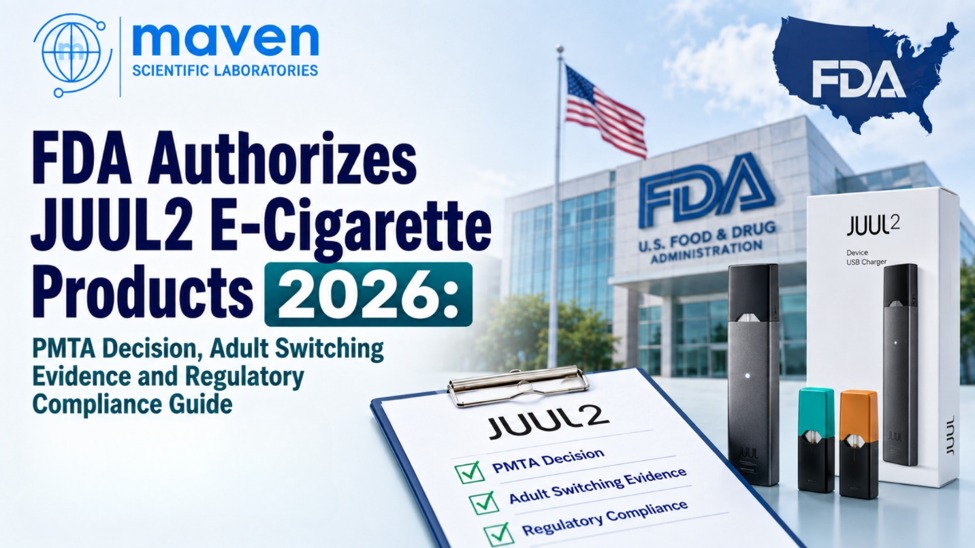
The U.S. Food and Drug Administration (FDA) has authorized the marketing of three new JUUL2 e-cigarette products through the Premarket Tobacco Product Application (PMTA) pathway.
The authorization, announced on August 28, 2026, covers the JUUL2 device, a tobacco-flavored pod and a menthol-flavored pod manufactured by JUUL Labs Inc.
FDA's decision followed a scientific review of evidence submitted in support of the products. The Agency evaluated whether the products met the statutory standard for authorization, including whether the potential benefits to the U.S. population outweigh the risks.
Importantly, FDA found that a substantial proportion of adults who smoke combustible cigarettes and use the authorized JUUL2 products completely switched away from cigarettes. FDA also found that adults who completely switched were exposed to lower levels of harmful chemicals than they would have been if they had continued smoking combustible cigarettes.
For tobacco and nicotine-product manufacturers, this decision provides important insight into FDA's current approach to PMTA evidence, population health considerations, adult switching, product risks, youth appeal and post-market regulatory oversight.
What Products Did FDA Authorize?
The August 2026 marketing authorization covers three products within the JUUL2 system:
| Authorized Product | Description |
| JUUL2 Device | Next-generation e-cigarette device |
| Tobacco-Flavored Pod | JUUL2-compatible tobacco-flavored pod |
| Menthol-Flavored Pod | JUUL2-compatible menthol-flavored pod |
The newly authorized pods contain 18 mg/mL nicotine, equivalent to approximately 1.5–1.6% nicotine concentration.
These authorizations are separate from FDA's July 2025 authorization of the original JUUL device and tobacco- and menthol-flavored JUUL pods at 3% and 5% nicotine concentrations.
Why the JUUL2 Authorization Is Significant
The decision demonstrates the importance of the population-health standard under the PMTA framework.
FDA does not evaluate a new tobacco product solely on whether an individual product presents risk. The Agency considers the broader effect of the product on the population, including potential benefits for adults who currently use tobacco products and potential risks to youth and people who do not use tobacco.
For manufacturers, this means a PMTA strategy must be considered more than product chemistry or toxicology.
A comprehensive submission may need to address:
- Product formulation
- Product design
- Aerosol characteristics
- Nicotine delivery
- Toxicological profile
- Clinical evidence
- Behavioral evidence
- Adult switching
- Youth initiation risk
- Marketing practices
- Population-level benefits and risks
Adult Switching Evidence
One of the most important aspects of the FDA's decision was evidence concerning adult smokers switching away from combustible cigarettes.
FDA reported that, in six weeks, 19.9% to 34.6% of adults using the tobacco-flavored JUUL2 pod had stopped smoking cigarettes entirely.
For the menthol-flavored pod, the corresponding complete-switching range was 28.4% to 49.3%. FDA noted that the menthol product demonstrated a higher rate of complete switching than the tobacco-flavored product.
These findings were important because FDA's regulatory assessment considers whether an authorized product can provide a potential benefit to adults who smoke while appropriately addressing risks to non-users and youth.
The evidence illustrates why behavioral and population-level data can be highly important components of a PMTA.
Reduced Exposure Does Not Mean Risk-Free
FDA's findings also highlight an important regulatory distinction.
Adults who completely switched from combustible cigarettes to the authorized JUUL2 products were exposed to lower levels of harmful chemicals than they would have been had they continued smoking cigarettes.
However, this does not mean that JUUL2 products are risk-free or that FDA considers them safe.
FDA's authorization means the Agency determined that the products met the applicable statutory standard for marketing authorization. Tobacco products remain subject to regulatory requirements and health risks.
This distinction is particularly important for manufacturers when developing:
- Product claims
- Marketing materials
- Consumer communications
- Promotional statements
- Regulatory submissions
Companies should avoid translating regulatory findings into unsupported claims that a product is “safe,” “FDA approved” or risk-free.
Menthol Product: Balancing Benefits and Risks
The authorization of the menthol-flavored JUUL2 pod is particularly notable.
FDA determined that the added benefit to adults who smoke cigarettes was sufficient to outweigh the risks associated with the menthol product, including youth appeal.
This demonstrates the complexity of FDA's population-health assessment.
Manufacturers of flavored tobacco products should therefore expect regulators to consider both:
Potential Adult Benefits → Switching from Combustible Cigarettes
and
Potential Public Health Risks → Youth Appeal and Initiation
A successful regulatory strategy must address both sides with scientifically credible evidence.
PMTA Evidence: What Manufacturers Should Learn
The JUUL2 decision provides several lessons for companies preparing PMTA submissions.
A strong submission should be supported by a comprehensive evidence package addressing the products:
Chemistry → Toxicology → Clinical Profile → Behavior → Adult Use → Youth Risk → Marketing → Population Impact
Evidence may include:
- Nonclinical studies
- Analytical chemistry
- Toxicological evaluations
- Clinical studies
- Pharmacokinetic assessments
- Behavioral studies
- Perception and intention studies
- Actually-use studies
- Biomarkers of exposure
- Population modeling
- Marketing plans
The objective is to demonstrate that the product's overall risk-benefit profile satisfies the applicable statutory standard.
Manufacturing and Product Quality Considerations
Marketing authorization also places continued importance on product quality and manufacturing controls.
Manufacturers should maintain appropriate controls over:
- Raw materials
- E-liquid formulation
- Nicotine concentration
- Pod components
- Device components
- Heating systems
- Aerosol characteristics
- Manufacturing processes
- Specifications
- Finished product testing
- Packaging and labeling
Consistency between the product described in the PMTA and the commercially manufactured product is essential.
Changes to formulation, components, manufacturing processes or product configuration may require regulatory assessment before implementation.
Post-Market Compliance Remains Important
FDA's authorization does not end regulatory obligations.
Manufacturers should continue monitoring:
- Product quality
- Consumer complaints
- Adverse experiences
- Product performance
- Youth use trends
- Adult switching patterns
- Marketing activities
- Manufacturing changes
- Emerging scientific evidence
Post-market information can become important for assessing whether a tobacco product continues to meet applicable regulatory expectations.
Companies should therefore establish robust post-market surveillance and regulatory intelligence programs.
Youth Protection and Marketing Controls
FDA has emphasized that authorized products must be marketed responsibly, particularly given concerns about youth exposure.
For manufacturers, marketing compliance should include careful review of:
- Advertising
- Promotional materials
- Digital marketing
- Social media
- Product imagery
- Flavor presentation
- Audience targeting
- Age restrictions
The authorization of a product does not provide unrestricted permission to market it in any manner.
Manufacturers must continue complying with applicable tobacco-product laws, regulations and FDA requirements.
2026 JUUL2 Regulatory Compliance Checklist
| Assessment Area | Objective |
| PMTA | Maintain regulatory compliance |
| Product Identity | Ensure authorized configuration |
| Formulation | Control nicotine and ingredients |
| Chemistry | Monitor harmful constituents |
| Toxicology | Maintain supporting evidence |
| Clinical Evidence | Support product claims |
| Switching Evidence | Monitor adult-use outcomes |
| Youth Risk | Evaluate initiation concerns |
| Manufacturing | Maintain product consistency |
| Labeling | Ensure regulatory compliance |
| Marketing | Prevent inappropriate claims |
| Complaints | Monitor product issues |
| Post-Market | Maintain ongoing surveillance |
| Change Control | Assess regulatory impact |
| Regulatory Intelligence | Monitor FDA developments |
What This Means for Tobacco Manufacturers
The JUUL2 decision reinforces that FDA's tobacco-product review is increasingly science-based, evidence-driven and population-focused.
For manufacturers, regulatory success depends on demonstrating not only that a product can be manufactured consistently, but also that its overall public-health profile supports authorization.
Companies developing new electronic nicotine delivery systems should consider integrating regulatory strategy early across:
R&D → Product Development → Analytical Testing → Toxicology → Clinical Research → Behavioral Science → PMTA → Manufacturing → Marketing → Post-Market Surveillance
Early coordination can help identify evidence gaps before submission and reduce the risk of regulatory delays.
Frequently Asked Questions
1. What did FDA authorize in August 2026?
FDA authorized three JUUL2 products through the PMTA pathway: the JUUL2 device, a tobacco-flavored pod and a menthol-flavored pod.
2. Does FDA authorization mean JUUL2 is safe?
No. Marketing authorization does not mean a tobacco product is risk-free or “FDA approved” in the same sense as a prescription drug. FDA's authorization means the products met the applicable legal standard for marketing.
3. What evidence supported the authorization?
FDA considered evidence addressing the products' risks and benefits, including evidence showing complete switching among adults who smoke and reduced exposure to harmful chemicals among those who completely switched.
4. How many adults completely switched in the six-week assessment?
FDA reported complete-switching ranges of 19.9–34.6% for the tobacco-flavored pod and 28.4–49.3% for the menthol-flavored pod at six weeks.
5. Why was the menthol authorization significant?
FDA determined that the potential benefit to adults who smoke was sufficient to outweigh the risks of the menthol product, including youth appeal.
6. Are the JUUL2 products the same as the JUUL products authorized in 2025?
No. FDA's 2026 authorization covers the JUUL2 system and its 18 mg/mL pods, while the 2025 authorization covered the original JUUL device and 3% and 5% nicotine tobacco- and menthol-flavored JUUL pods.
Conclusion
FDA's authorization of the JUUL2 device and tobacco- and menthol-flavored pods represents an important development in the U.S. electronic nicotine delivery system market.
The decision demonstrates the importance of comprehensive PMTA evidence, particularly evidence addressing product chemistry, toxicology, clinical performance, adult switching, youth risks and population-level health effects.
For manufacturers, the key lesson is that successful tobacco-product authorization requires a multidisciplinary and evidence-driven regulatory strategy.
Companies should ensure that product development, analytical science, toxicology, clinical research, behavioral evidence, manufacturing controls, marketing plans and post-market surveillance are aligned from the beginning.
The JUUL2 decision also reinforces an important distinction: FDA marketing authorization is not a declaration that an e-cigarette product is safe. It reflects FDA's determination that the specific products meet the applicable statutory requirements for marketing.
As FDA continues to evaluate electronic nicotine delivery systems, manufacturers should closely monitor regulatory developments and ensure their PMTA strategies remain aligned with evolving scientific and population-health expectations.
How Maven Regulatory Solutions Can Help
Maven Regulatory Solutions can support tobacco and nicotine-product companies with:
- PMTA regulatory strategy
- PMTA submission support
- Regulatory gap assessments
- Scientific evidence strategy
- Toxicology and risk assessment coordination
- Clinical and behavioral evidence review
- Product chemistry assessment
- Manufacturing and CMC documentation review
- Labeling and marketing compliance
- Post-market regulatory support
- FDA regulatory intelligence
- Lifecycle regulatory management
Our approach helps companies build evidence-based, scientifically justified and FDA-aligned regulatory strategies for tobacco and nicotine products.

Post a comment