
October 28, 2026
What CDRH’s FY 2027 Guidance Agenda Means for Medical Device Manufacturers and AI Developers
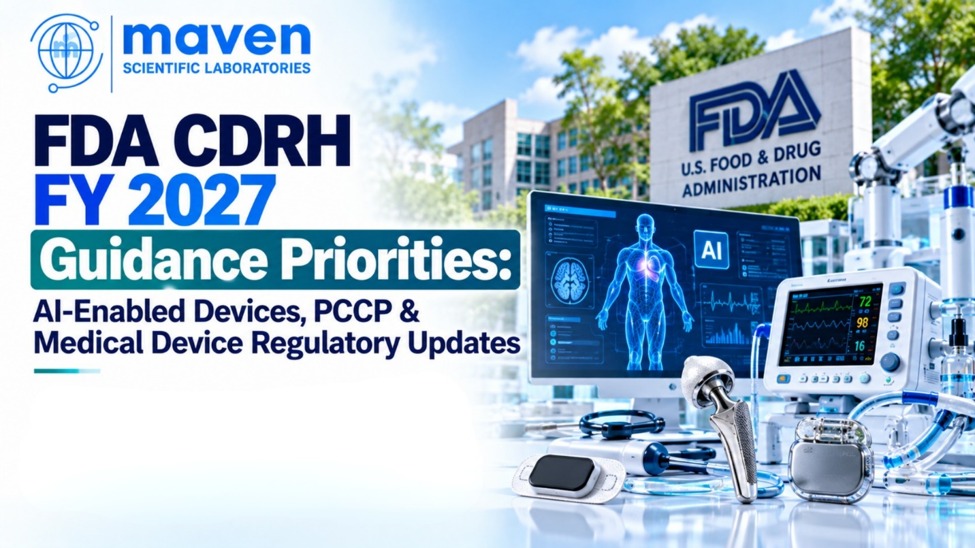
The U.S. Food and Drug Administration (FDA) Center for Devices and Radiological Health (CDRH) has identified its priority guidance-development agenda for fiscal year 2027, highlighting artificial intelligence (AI), software-enabled medical devices and lifecycle regulatory management.
On 1 October 2026, CDRH announced that it plans to publish 11 final guidance documents and three draft guidance documents during FY 2027.
A major priority is finalizing guidance for artificial intelligence-enabled medical devices throughout their product lifecycle, together with guidance on predetermined change control plans (PCCPs).
The FY 2027 agenda provide manufacturers, developers and regulatory teams with an important indication of where FDA medical device policy is heading.
For companies developing or maintaining AI-enabled devices, the upcoming guidance may influence product development, regulatory submissions, software modifications, change management, post-market monitoring and lifecycle compliance strategies.
Companies should therefore monitor the CDRH agenda closely and assess how emerging guidance may affect their current and future device portfolios.
Why CDRH’s FY 2027 Guidance Agenda Matters
Medical device technology is evolving rapidly, particularly in areas involving:
- Artificial intelligence and machine learning
- Software as a medical device
- Adaptive algorithms
- Digital health technologies
- Automated clinical decision support
- Connected medical devices
- Real-world performance monitoring
- Software modifications and updates
Traditional regulatory approaches can become challenging when a device is expected to evolve after authorization.
AI-enabled devices may undergo software changes, model updates, performance improvements or modifications based on new data.
This creates an important regulatory question:
How can manufacturers manage device changes throughout the product lifecycle without requiring a completely new regulatory submission for every anticipated modification?
FDA's work on predetermined change control plans is particularly relevant to this issue.
A well-designed PCCP can provide a structured framework for certain planned device modifications while maintaining appropriate controls over safety and effectiveness.
What CDRH Announced for FY 2027
CDRH's FY 2027 agenda is divided into three categories:
- A List – Priority Guidance
- B List – Guidance as Resources Become Available
- Under Construction – Additional Guidance Development
CDRH plans to publish 11 final guidance documents and three draft guidance documents during the fiscal year.
The A List represents the highest-priority guidance activities, making it particularly important for manufacturers and regulatory professionals tracking upcoming FDA policy developments.
FY 2027 CDRH Guidance Categories
|
Guidance Category |
Meaning |
Industry Relevance |
|
A List |
Priority guidance documents CDRH intends to address |
Highest priority for regulatory monitoring |
|
B List |
Guidance planned as resources become available |
Monitor for future regulatory impact |
|
Under Construction |
Additional guidance CDRH intends to develop |
Early-stage regulatory intelligence opportunity |
The agenda should not be interpreted as a guarantee that every guidance document will be issued exactly according to a particular timetable. Rather, it provides industry with visibility into CDRH's regulatory priorities.
AI-Enabled Medical Devices Take Center Stage
One of the most significant priorities for FY 2027 is guidance concerning AI-enabled devices across their product lifecycle.
Artificial intelligence is increasingly incorporated into medical technologies used for:
- Diagnostic support
- Medical imaging
- Clinical decision support
- Patient monitoring
- Risk prediction
- Disease detection
- Personalized treatment support
- Digital therapeutics
- Remote patient management
AI-enabled devices can introduce regulatory considerations that extend beyond the initial product authorization.
Manufacturers may need to consider how AI functionality is:
- Developed
- Validated
- Updated
- Monitored
- Modified
- Documented
- Controlled after commercialization
Lifecycle-focused FDA guidance could therefore become an important reference for organizations developing AI-enabled medical devices.
Predetermined Change Control Plans: A Major Regulatory Priority
PCCPs are particularly important for medical devices that are expected to undergo planned modifications.
A predetermined change control plan can be established in advance:
- What changes are intended
- Why the changes are needed
- How changes will be implemented
- How performance will be evaluated
- What validation activities will be performed
- What controls will be applied
- How the manufacturer will maintain safety and effectiveness
For AI-enabled devices, PCCPs can be especially relevant because algorithms may require controlled updates over time.
Key PCCP Considerations
|
PCCP Area |
Key Question for Manufacturers |
|
Planned Changes |
What modifications are reasonably anticipated? |
|
Change Boundaries |
What limits define acceptable changes? |
|
Validation |
How will each modification be evaluated? |
|
Performance |
How will safety and effectiveness be demonstrated? |
|
Risk Management |
What new risks could the modification introduce? |
|
Documentation |
What records will demonstrate compliance? |
|
Post-Market Monitoring |
How will device performance be monitored after changes? |
Companies developing AI-enabled devices should consider PCCP strategy early rather than treating it solely as a post-submission activity.
What AI Device Manufacturers Should Review
Manufacturers should evaluate their current AI and software development processes against emerging FDA expectations.
A comprehensive review can include:
- AI/ML functionality
- Intended use
- Indications for use
- Algorithm architecture
- Training and validation datasets
- Performance characteristics
- Bias and subgroup performance
- Cybersecurity considerations
- Software lifecycle controls
- Change-management procedures
- Risk management
- Verification and validation
- Post-market monitoring
- Real-world performance
- Documentation and submission strategy
The objective should be to establish a lifecycle framework that can accommodate planned technological evolution while maintaining regulatory control.
Impact on Medical Device Manufacturers
The FY 2027 guidance agenda may have implications across multiple functions.
|
Business Function |
Potential Impact |
|
Regulatory Affairs |
Monitoring and implementation of new FDA guidance |
|
R&D |
Integration of regulatory expectations into product development |
|
Software Engineering |
Controlled software and algorithm modification |
|
Quality |
Documentation, validation and change-control processes |
|
Clinical |
Evidence generation and performance assessment |
|
Data Science |
Dataset governance and algorithm evaluation |
|
Post-Market Surveillance |
Monitoring real-world device performance |
|
Management |
Lifecycle strategy and regulatory risk planning |
This makes FDA guidance monitoring a cross-functional activity rather than a responsibility limited to regulatory affairs.
Regulatory Readiness Checklist for FY 2027
Companies developing AI-enabled or software-driven medical devices should consider the following readiness activities.
|
Assessment Area |
Recommended Action |
|
Device Portfolio |
Identify AI-enabled and software-based devices |
|
Regulatory Status |
Review current FDA authorization pathway |
|
AI Functionality |
Document AI/ML features and intended use |
|
Change Management |
Review procedures for planned software modifications |
|
PCCP Strategy |
Determine whether a PCCP could support lifecycle changes |
|
Risk Management |
Assess risks associated with algorithm modifications |
|
Validation |
Review verification and validation protocols |
|
Clinical Evidence |
Evaluate evidence supporting performance |
|
Post-Market |
Strengthen real-world performance monitoring |
|
Regulatory Intelligence |
Track FY 2027 CDRH guidance developments |
What Companies Should Do Before New Guidance Is Finalized
Manufacturers do not necessarily need to wait for final FDA guidance before strengthening their regulatory systems.
Companies can begin by performing a regulatory gap assessment.
1. Identify AI-Enabled Devices
Create an inventory of products that use AI, machine learning, predictive algorithms or automated decision-support functionality.
2. Existing Regulatory Submissions
Assess whether existing 510(k), De Novo, PMA or other submissions adequately describe software functionality, algorithm performance and planned modifications.
3. Evaluate Change-Control Procedures
Determine whether current procedures clearly distinguish between minor software updates and changes that could affect safety or effectiveness.
4. Assess PCCP Opportunities
For products expected to undergo planned modifications, evaluate whether a PCCP strategy could provide greater lifecycle flexibility.
5. Strengthen Evidence Planning
Ensure that verification, validation and clinical evidence strategies are aligned with the device's intended use and anticipated changes.
6. Establish Regulatory Intelligence
Track FDA announcements, guidance publications and related policy developments so that internal procedures can be updated promptly.
Potential Challenges for AI Medical Device Companies
Organizations may encounter several challenges when implementing lifecycle-based AI regulatory strategies.
Common issues include:
- Rapid technology changes
- Unclear boundaries for planned modifications
- Limited historical performance data
- Dataset variability
- Algorithm drift
- Subgroup performance differences
- Software validation complexity
- Changing clinical environments
- Cybersecurity risks
- Documentation gaps
- Lack of cross-functional ownership
These challenges reinforce the importance of integrating regulatory strategy into the entire product lifecycle.
FDA AI and PCCP Strategy: Practical Roadmap
A practical approach can include:
Step 1: Identify AI-enabled and software-based products.
Step 2: Classify devices according to their current FDA regulatory pathway.
Step 3: Map AI functionality and planned software changes.
Step 4: Review risk management and software lifecycle documentation.
Step 5: Assess whether a PCCP may be appropriate.
Step 6: Define anticipated modifications and change boundaries.
Step 7: Establish validation and performance-monitoring requirements.
Step 8: Review clinical and real-world evidence strategies.
Step 9: Monitor final FDA guidance as it becomes available.
Step 10: Update regulatory, quality and lifecycle management procedures accordingly.
Early preparation can help companies reduce regulatory uncertainty and build greater flexibility into their device lifecycle strategies.
Frequently Asked Questions
1. What is CDRH's FY 2027 guidance agenda?
It is FDA CDRH's planned guidance-development agenda for fiscal year 2027. CDRH announced plans to publish 11 final guidance documents and three draft guidance documents.
2. What is one of the key FY 2027 priorities?
A major priority is finalizing guidance addressing AI-enabled devices throughout their product lifecycle, along with guidance concerning predetermined change control plans.
3. Why is PCCP important for AI-enabled devices?
AI-enabled devices may require planned software or algorithm modifications after authorization. A PCCP can provide a structured framework for managing certain anticipated changes while maintaining appropriate controls.
4. Does the agenda only affect AI medical devices?
No. The agenda covers broader medical device regulatory topics. However, AI-enabled devices and lifecycle change management are particularly important areas identified in the FY 2027 priorities.
5. Should manufacturers wait for final guidance before taking action?
No. Companies can begin reviewing their AI governance, software lifecycle controls, change management, validation and regulatory strategies while continuing to monitor FDA developments.
6. Which teams should monitor the new guidance?
Regulatory Affairs, Quality, R&D, software engineering, clinical teams, data science, cybersecurity and post-market surveillance functions may all be affected.
7. Can a PCCP eliminate the need for future FDA review?
Not necessarily. The applicability and regulatory effect of a PCCP depend on the specific device, proposed changes and applicable FDA requirements. Manufacturers should evaluate their strategy against the applicable regulatory pathway and FDA expectations.
Conclusion
FDA CDRH's FY 2027 guidance agenda signals continued regulatory attention toward artificial intelligence, software-driven medical devices and lifecycle management.
The planned guidance on AI-enabled devices and predetermined change control plans is particularly significant for manufacturers developing technologies that are expected to evolve after authorization.
Rather than treating regulatory compliance as a one-time submission activity, medical device companies should increasingly consider compliance as a continuous product lifecycle process.
Organizations should begin reviewing their AI governance, software change controls, validation strategies, clinical evidence, risk management and post-market monitoring systems.
Monitoring the FY 2027 CDRH agenda can help companies anticipate regulatory developments and prepare their product portfolios for evolving FDA expectations.
How Maven Regulatory Solutions Can Help
Maven Regulatory Solutions can support medical device and AI technology companies with:
- FDA medical device regulatory strategy
- AI-enabled medical device regulatory assessment
- PCCP strategy and assessment
- 510(k) regulatory support
- De Novo pathway support
- PMA regulatory support
- Software as a Medical Device (SaMD) compliance
- AI/ML device regulatory consulting
- Regulatory gap assessments
- Risk management support
- Clinical and performance evidence strategy
- Verification and validation documentation
- Submission strategy and preparation
- Change-control assessments
- Post-market regulatory support
- FDA regulatory intelligence
- Product lifecycle management
Our regulatory approach helps manufacturers integrate FDA requirements into product development, submission planning, change management and post-market lifecycle strategies.

Post a comment