
October 21, 2026
What Manufacturers, Sponsors and Regulatory Teams Need to Know About USFDA Application Pathways
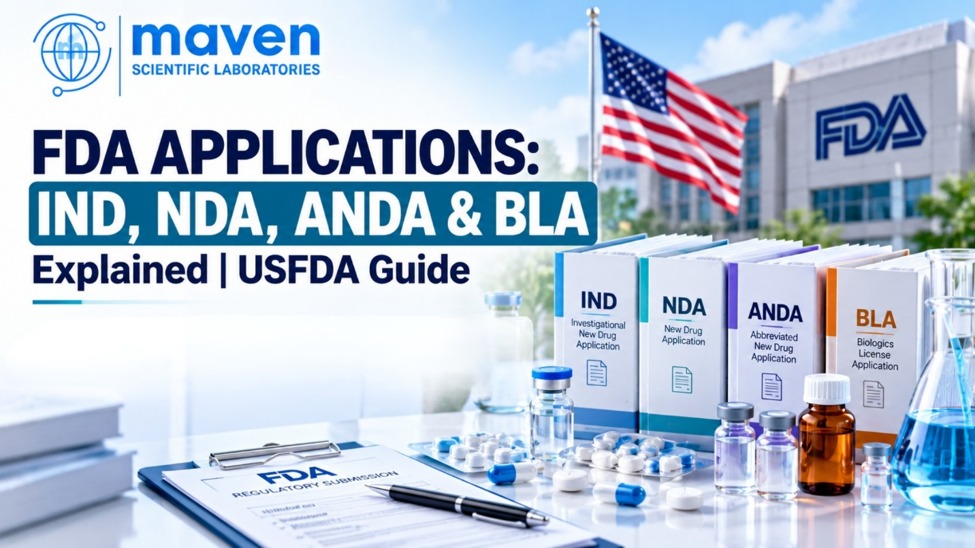
Navigating the US Food and Drug Administration (FDA) regulatory landscape requires companies to understand which application pathway applies to their product, development stage and commercialization strategy.
Different FDA applications support different stages of the product lifecycle, from first-in-human clinical investigation through marketing approval and commercialization.
For drug and biologic developers, the key application pathways include:
- Investigational New Drug (IND)
- New Drug Application (NDA)
- Abbreviated New Drug Application (ANDA)
- Biologics License Application (BLA)
Within these pathways, FDA regulations provide different routes depending on whether the product is an original drug, a generic, a modified product, a reference biologic or a biosimilar.
Understanding these distinctions is important because selecting the wrong pathway can affect clinical development strategy, evidence requirements, regulatory timelines, intellectual property considerations, labeling and FDA interactions.
Why Understanding FDA Application Types Matters
The FDA application pathway is closely connected to the product's regulatory status and development strategy.
An application may be intended to:
- Authorize clinical investigation
- Support development of a new drug
- Obtain marketing approval
- Establish a generic drug's bioequivalence
- Support approval of a modified drug product
- License is an innovator biologic
- Obtain biosimilar or interchangeable biosimilar licensure
The IND is not a marketing application. It generally provides the regulatory mechanism for conducting clinical investigations with an investigational drug, while an NDA, ANDA or BLA is used for marketing authorization or licensure, as applicable.
Companies should therefore assess the application pathway at an early stage of product development rather than treating regulatory submission as a final-stage activity.
1. IND — Investigational New Drug Application
An IND is used to support the clinical investigation of an investigational drug in humans.
FDA explains that INDs generally fall into two categories: Commercial and Research (non-commercial). FDA also identifies specific types including Investigator INDs, Emergency Use INDs and Treatment INDs.
1. Commercial IND
A Commercial IND is generally submitted by a company or sponsor whose ultimate objective is to develop and obtain marketing approval for the product.
It supports clinical development activities intended to generate evidence for a future marketing application.
2. Investigator IND
An Investigator IND is submitted by a physician who both initiates and conducts the investigation and is responsible for administration or dispensing of the investigational drug.
It may be used to study an unapproved drug or an approved product for a new indication, patient population or other research purposes.
3. Emergency Use IND
An Emergency Use IND (EIND) allows FDA authorization for use of an experimental drug in an emergency where there is insufficient time for a conventional IND submission.
It can also apply in certain circumstances where a patient does not meet an existing study protocol, or an approved protocol is not available.
4. Treatment IND
A Treatment IND is associated with expanded access for an investigational drug that is showing promise for patients with serious or immediately life-threatening conditions while clinical development and FDA review continue.
Key IND Considerations
An IND submission generally addresses three broad areas:
- Nonclinical pharmacology and toxicology
- Manufacturing information
- Clinical protocols and investigator information
The objective is to provide information supporting the safe initiation or continuation of clinical investigation.
2. NDA — New Drug Application
A New Drug Application (NDA) is a marketing application used when a sponsor seeks FDA approval to market a new drug.
FDA's NDA review considers information from areas including chemistry, pharmacology, medical sciences, biopharmaceutics and statistics.
There are two major statutory pathways commonly encountered in NDA development:
1. 505(b)(1) Full NDA
A 505(b)(1) NDA contains full reports of investigations of safety and effectiveness.
The applicant relies on investigations conducted by or for the applicant, or investigations for which the applicant has obtained a right of reference or use.
This pathway is generally associated with original drug development where the sponsor is responsible for generating or legally accessing the required evidence.
2. 505(b)(2) NDA
A 505(b)(2) NDA is submitted under section 505(b) but may rely partly on investigations that were not conducted by or for the applicant and for which the applicant does not have a right of reference or use.
FDA may rely on existing information, such as published literature or previous FDA findings of safety and effectiveness, where legally and scientifically appropriate.
This pathway can be particularly relevant to certain new formulations, dosage forms, strengths, routes of administration or other modifications where a complete stand-alone development program may not be necessary.
3. ANDA — Abbreviated New Drug Application
An Abbreviated New Drug Application (ANDA) is the principal application pathway for approval of eligible generic drug products.
Unlike an NDA, an ANDA generally does not require the applicant to independently establish the full clinical safety and effectiveness profile of the active ingredient in the same manner as an original new drug application.
Instead, the applicant relies on the established reference listed drug framework and demonstrates that the proposed generic satisfies applicable requirements, including bioequivalence.
Standard ANDA
A standard ANDA generally proposes a generic drug product referencing an FDA-approved Reference Listed Drug (RLD).
The applicant must demonstrate compliance with applicable requirements for pharmaceutical equivalence, bioequivalence, manufacturing, labeling and other regulatory elements.
ANDA Following a Suitability Petition
FDA permits certain differences between a proposed generic product and its RLD when those differences are authorized through an approved suitability petition under section 505(j)(2)(C) and 21 CFR 314.93.
Potential differences can involve:
- Route of administration
- Dosage form
- Strength
- One different active ingredient in certain fixed-combination products
The suitability petition must be approved before the ANDA relying on that petition can be submitted for review.
Therefore, it is more precise to describe this as an ANDA supported by an approved suitability petition, rather than as an entirely separate ANDA application type.
4. BLA — Biologics License Application
A Biologics License Application (BLA) is used to seek licensure of biological products regulated under the applicable provisions of the Public Health Service Act.
Two major statutory pathways are particularly important:
1. 351(a) Stand-Alone BLA
A 351(a) BLA is generally used for an original biological product for which the sponsor is seeking licensure based on its own development and supporting evidence.
This pathway is commonly associated with innovator biological products.
2. 351(k) Biosimilar BLA
A 351(k) BLA is used to seek licensure of a proposed biosimilar biological product.
The applicant must demonstrate that the proposed product is biosimilar to the reference product and satisfy applicable statutory and regulatory requirements.
FDA describes a biosimilar as highly like the reference product, notwithstanding minor differences in clinically inactive components, with no clinically meaningful differences in safety, purity and potency.
A 351(k) pathway can also involve interchangeability, where the applicable statutory requirements are met. FDA distinguishes interchangeable biosimilars from biosimilars that have not established interchangeability.
FDA Application Types briefly
|
Application |
Primary Purpose |
Key Pathways / Categories |
Typical Regulatory Objective |
|
IND |
Clinical investigation |
Commercial, Research; Investigator, Emergency Use, Treatment |
Authorize/support clinical investigation |
|
NDA |
New drug marketing approval |
505(b)(1), 505(b)(2) |
Obtain approval for a new drug |
|
ANDA |
Generic drug approval |
Standard ANDA; ANDA supported by suitability petition where applicable |
Obtain approval for an eligible generic |
|
BLA |
Biological product licensure |
351(a), 351(k) |
License innovator biologic or biosimilar |
FDA itself identifies IND, NDA, ANDA and BLA among the principal application types within the drug development and approval framework.
How the Pathways Fit into the Product Lifecycle
The appropriate FDA application depends heavily on where the product is in its development and commercialization lifecycle.
|
Lifecycle Stage |
Potential Application |
Primary Regulatory Question |
|
Preclinical → Human Studies |
IND |
Can the investigational product be studied in humans under applicable FDA requirements? |
|
Clinical Development |
IND |
Can clinical development continue under the applicable IND framework? |
|
Original Small-Molecule Drug |
505(b)(1) NDA |
Does the sponsor have sufficient evidence for marketing approval? |
|
Modified/Hybrid Drug Development |
505(b)(2) NDA |
Can existing information support some aspects of the application? |
|
Generic Drug Development |
ANDA |
Does the proposed generic meet applicable requirements, including bioequivalence? |
|
Original Biologic |
351(a) BLA |
Does the biological product meet requirements for licensure? |
|
Biosimilar Development |
351(k) BLA |
Is the proposed product biosimilar to the reference product? |
The actual pathway must be determined based on the product's characteristics, regulatory history, intended use, reference product status and applicable FDA requirements.
Key Regulatory Considerations by Application Type
|
Application |
Major Evidence / Documentation Areas |
Important Compliance Focus |
|
IND |
Nonclinical data, CMC, clinical protocols, investigator information |
Clinical safety, protocol compliance, CMC and safety reporting |
|
NDA |
CMC, nonclinical and clinical data, labeling, statistical analyses |
Safety, effectiveness, quality and benefit-risk |
|
ANDA |
Pharmaceutical equivalence, bioequivalence, CMC, labeling |
Reference product comparison, bioequivalence and quality |
|
BLA |
CMC, nonclinical and clinical evidence, manufacturing controls, labeling |
Safety, purity, potency and biological product quality |
FDA notes that IND submissions include nonclinical, manufacturing and clinical information, while marketing applications require comprehensive information appropriate to the applicable regulatory pathway.
Who Should Pay Attention?
The FDA application framework is particularly relevant to:
- Pharmaceutical manufacturers
- Biotechnology companies
- Biologics developers
- Generic drug manufacturers
- Contract development and manufacturing organizations
- Clinical-stage companies
- Specialty pharmaceutical companies
- Regulatory affairs teams
- Clinical development teams
- CMC teams
- Quality assurance organizations
- Medical writing teams
- Regulatory consultants
- Companies planning US market entry
Companies developing products for the US market should determine the appropriate application pathway early enough to align clinical strategy, CMC development, regulatory interactions, documentation and submission planning.
Frequently Asked Questions
1. What is an IND?
An Investigational New Drug Application (IND) is the FDA mechanism used to support applicable clinical investigations of investigational drugs. It is not a marketing approval application.
2. What are the main IND categories?
FDA identifies Commercial and Research (non-commercial) as the two broad IND categories. Investigator, Emergency Use and Treatment INDs are specific types associated with these categories.
3. What is the difference between 505(b)(1) and 505(b)(2)?
A 505(b)(1) application contains full reports of investigations of safety and effectiveness relied upon for approval. A 505(b)(2) application can rely, where permitted, on certain information not developed by or for the applicant, including published literature or FDA's previous findings.
4. What is an ANDA?
An ANDA is the principal FDA application pathway for eligible generic drug products.
5. Is a suitability petition a separate type of ANDA?
Not technically. A suitability petition is a regulatory mechanism that can permit certain differences from an RLD. FDA must approve the petition before an ANDA relying on it can be submitted for review.
6. What is BLA?
A Biologics License Application (BLA) is used to seek licensure of applicable biological products.
7. What is the difference between 351(a) and 351(k)?
A 351(a) pathway is generally used for an original biological product, while 351(k) is the statutory pathway for biosimilar products.
8. Does a biosimilar BLA automatically mean the product is interchangeable?
No. Bio similarity and interchangeability are distinct regulatory concepts. An interchangeable biosimilar must meet the applicable additional statutory requirements.
9. Can the same company use different FDA application pathways?
Yes. A company's portfolio may contain products requiring different regulatory pathways depending on product type, development strategy, reference product status and intended use.
10. When should the FDA pathway be determined?
The regulatory pathway should ideally be evaluated early in product development, because it can influence clinical studies, CMC strategy, evidence generation, regulatory interactions, timelines and submission planning.
Conclusion
Understanding FDA application types is fundamental to developing an effective US regulatory strategy.
The principal pathways include IND, NDA, ANDA and BLA, but each pathway contains important distinctions.
For INDs, companies must understand the distinction between commercial and research/non-commercial categories and specific types such as Investigator, Emergency Use and Treatment INDs.
For new drugs, the distinction between 505(b)(1) and 505(b)(2) can significantly influence evidence strategy.
For generic drugs, the ANDA pathway is central, while a suitability petition may be required where certain permitted differences from the reference listed drug are proposed.
For biological products, the distinction between 351(a) and 351(k) is essential for determining whether the product follows an innovator or biosimilar development pathway.
The correct application strategy should therefore be established based on the product's scientific characteristics, regulatory status, development objectives and intended US market pathway.
A proactive regulatory assessment can help companies reduce development uncertainty, identify evidence gaps and prepare more efficiently for FDA interactions and submissions.
How Maven Regulatory Solutions Can Help
Maven Regulatory Solutions can support companies with:
- FDA regulatory pathway assessment
- IND strategy and regulatory support
- Commercial and non-commercial IND assessments
- Investigator and Treatment IND support
- Emergency Use IND assessments
- NDA pathway assessment
- 505(b)(1) and 505(b)(2) strategy
- ANDA regulatory assessments
- Suitability petition assessments
- BLA pathway assessment
- 351(a) and 351(k) strategy
- Biosimilar regulatory support
- Regulatory gap assessments
- CMC regulatory strategy
- Clinical regulatory support
- FDA submission planning
- Regulatory intelligence
- Product lifecycle management
- US market-entry regulatory assessments
Our approach helps pharmaceutical and biotechnology companies identify the appropriate FDA pathway, assess regulatory requirements and develop practical strategies for clinical development, marketing applications, biologics licensure and lifecycle compliance.

Post a comment