
July 10, 2026
How the Latest European Commission Decision Impacts MDR Compliance, Technical Documentation, CE Marking, and Harmonized Standards
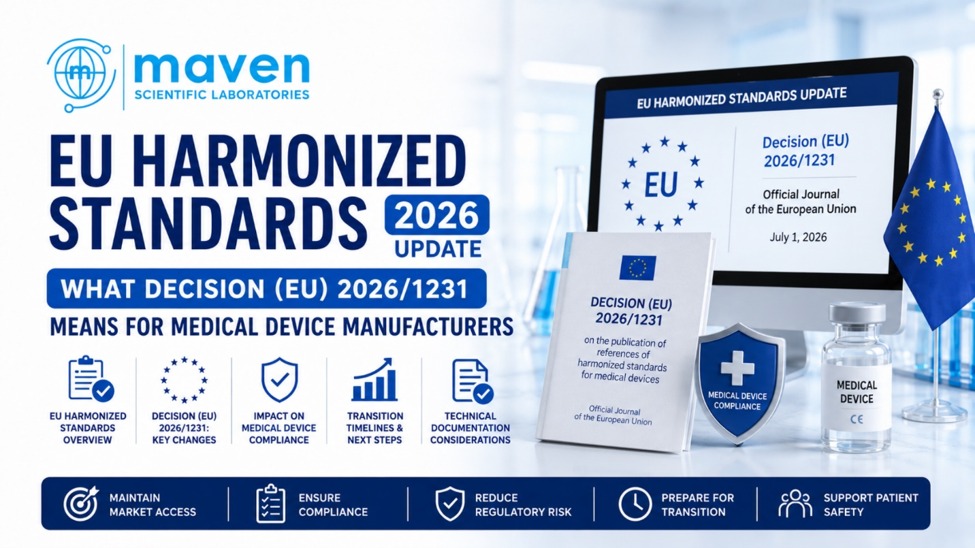
The European Commission's Implementing Decision (EU) 2026/1231, published on 25 June 2026, updates the list of harmonized standards supporting compliance with the EU Medical Device Regulation (MDR) (EU) 2017/745. The decision introduces new standards and amendments across biological evaluation, medical electrical equipment, labeling symbols, transfusion equipment, ophthalmic optics, implants, prosthetics, washer-disinfectors, and sharps injury protection. Manufacturers should review technical documentation, Declarations of Conformity, testing records, and quality management systems to ensure continued compliance and maintain the presumption of conformity.
Why This Update Matters
Regulatory compliance for medical devices is constantly evolving. As standards are revised to reflect technological innovation, clinical evidence, and improved safety requirements, manufacturers are expected to keep their products and documentation aligned with the latest harmonized standards.
Commission Implementing Decision (EU) 2026/1231 is more than a routine standards update it directly affects how manufacturers demonstrate conformity with the EU MDR and prepare for audits, conformity assessments, and market surveillance activities.
Organizations that proactively adopt the updated standards can streamline regulatory submissions, reduce compliance risks, and strengthen confidence with Notified Bodies and competent authorities.
Conversely, relying on outdated standards may result in technical documentation gaps, delayed CE marking activities, increased audit observations, and additional regulatory scrutiny.
What's New in Decision (EU) 2026/1231?
The latest decision revises several existing harmonized standards while introducing new standards that cover a broad range of medical device categories.
Some of the most significant updates include amendments to:
- EN ISO 10993-23 for irritation testing
- EN ISO 10993-12 for sample preparation and reference materials
- EN ISO 15223-1 for medical device symbols and labeling
- EN IEC 60601-2-83 for home light therapy equipment
- EN ISO 10993-17 for toxicological risk assessment
The decision also adds new harmonized standards addressing:
- Transfusion equipment
- Biological evaluation
- Ophthalmic optics
- Non-active surgical implants
- Washer-disinfectors
- Prosthetics
- Sharps injury protection
- Medical electrical equipment
These updates ensure manufacturers have access to the latest internationally recognized technical specifications for demonstrating compliance with MDR requirements.
Key Areas Covered by Decision (EU) 2026/1231
| Technical Area | Purpose |
| Biological Evaluation | Assess biocompatibility and patient safety |
| Medical Electrical Equipment | Ensure electrical safety and essential performance |
| Device Symbols | Standardize labeling and instructions for use |
| Transfusion Equipment | Improve safety of blood and infusion devices |
| Ophthalmic Optics | Update requirements for frames and spectacle lenses |
| Surgical Implants | Strengthen implant performance requirements |
| Washer-Disinfectors | Improve cleaning and disinfection validation |
| Prosthetics | Enhance mechanical testing requirements |
| Sharps Injury Protection | Reduce occupational injury risks |
Who Should Pay Attention to This Update?
Decision (EU) 2026/1231 affects nearly every organization involved in the design, manufacture, testing, distribution, or regulatory management of medical devices marketed in Europe.
The update is particularly important for:
- Medical device manufacturers
- Regulatory Affairs professionals
- Quality Assurance teams
- Product Development engineers
- Design and R&D teams
- Clinical Affairs specialists
- Testing laboratories
- Notified Bodies
- Authorized Representatives
- Importers and distributors managing technical documentation
Whether your company develops Class I devices or high-risk implantable technologies, staying aligned with harmonized standards is essential for maintaining regulatory compliance.
Why Harmonized Standards Are So Important Under the EU MDR
Unlike regulations, harmonized standards are generally voluntary. However, they provide manufacturers with one of the most efficient ways to demonstrate conformity with the General Safety and Performance Requirements (GSPRs) under the MDR.
Using the latest harmonized standards offers several practical advantages:
- Supports presumption of conformity
- Simplifies conformity assessments
- Strengthens technical documentation
- Reduces regulatory uncertainty
- Improves product consistency
- Facilitates CE marking
- Enhances patient safety
- Supports smoother Notified Body reviews
Failing to monitor updates may require manufacturers to justify alternative approaches or provide additional technical evidence during regulatory assessments.
Revised Harmonized Standards Included in the Decision
| Previous Standard | Updated Reference | Regulatory Focus |
| EN ISO 10993-23:2021 | EN ISO 10993-23:2021/A1:2025 | Irritation testing |
| EN ISO 10993-12:2021 | EN ISO 10993-12:2021/A1:2025 | Sample preparation |
| EN ISO 15223-1:2021 | EN ISO 15223-1:2021/A1:2025 | Medical device labeling symbols |
| EN IEC 60601-2-83:2020 | EN IEC 60601-2-83:2020/A1:2025 | Home light therapy equipment |
| EN ISO 10993-17:2023 | EN ISO 10993-17:2023/A1:2025 | Toxicological risk assessment |
What This Means for Your Technical Documentation
All harmonized standards update has a direct impact on technical documentation.
Manufacturers should evaluate whether current documentation still references valid standards or whether amendments and new editions must be incorporated.
Key documents that should be reviewed include:
- Technical Files
- Design Dossiers
- Risk Management Files
- Biological Evaluation Reports
- Clinical Evaluation Reports
- Verification and Validation Reports
- Test Certificates
- Usability Engineering Files
- Software Documentation (where applicable)
- Post-Market Surveillance documentation
Even if product design remains unchanged, documentation referencing obsolete standards may require updates during periodic reviews or regulatory inspections.
Compliance Risks of Ignoring the Update
Many organizations underestimate the impact of harmonized standards revisions, assuming existing certifications remain unaffected. While immediate product redesign is not always necessary, failing to assess the implications of updated standards can create significant regulatory challenges over time.
Potential risks include:
- Technical documentation inconsistencies
- Nonconformities during Notified Body audits
- Delays in CE marking renewals
- Increased requests for clarification from competent authorities
- Additional testing costs
- Product launch delays
- Market surveillance findings
- Greater lifecycle management complexity
A structured impact assessment allows manufacturers to prioritize updates based on product risk, regulatory timelines, and business objectives.
Immediate Action Checklist for Manufacturers
| Action | Priority |
| Review affected harmonized standards | High |
| Identify impacted product families | High |
| Update technical documentation | High |
| Review Declarations of Conformity | High |
| Assess testing and validation reports | Medium |
| Verify labeling and symbols | Medium |
| Update internal standards register | Medium |
| Train regulatory and quality teams | Medium |
| Document impact assessment | High |
Expert Insight
One of the biggest misconceptions surrounding harmonized standards is that updating the standard automatically requires redesigning the product. Manufacturers should first perform a documented gap assessment to determine whether the revised standard introduces technical changes that affect product safety, performance, testing, labeling, or regulatory documentation.
A well-executed impact assessment helps organizations allocate resources efficiently, prioritize high-risk updates, and maintain continuous compliance without unnecessary disruption to product development or market supply.
Common Compliance Mistakes Manufacturers Should Avoid
As new harmonized standards are introduced or existing standards are amended, many manufacturers focus only on updating their standards register. However, regulatory compliance extends far beyond replacing a reference number in documentation.
Failure to conduct a comprehensive impact assessment can lead to compliance gaps that may only become apparent during a Notified Body audit or market surveillance inspection.
The most common mistakes include:
1. Delaying the Impact Assessment
Waiting until the next surveillance audit to review harmonized standards can create unnecessary regulatory pressure. Every newly published or amended standard should trigger a documented assessment to determine its impact on affected products.
2. Updating Standards Without Reviewing Supporting Evidence
Updating a Declaration of Conformity without verifying associated test reports, biological evaluations, or risk management documentation may create inconsistencies that auditors can identify during technical file reviews.
3. Overlooking Labeling and IFU Requirements
Amendments to standards such as EN ISO 15223-1 may affect device symbols, instructions for use (IFUs), packaging artwork, and electronic labeling. These changes should be coordinated across Regulatory Affairs, Quality Assurance, and Labeling teams.
4. Ignoring Legacy Products
Even products already placed on the market may require documentation updates as part of lifecycle management, particularly when significant amendments affect safety or performance expectations.
5. Failing to Train Cross-Functional Teams
Engineering, Regulatory Affairs, Quality Assurance, Clinical Affairs, and Manufacturing teams should all understand how revised harmonized standards influence design controls, testing, and post-market activities.
Best Practices for Implementing Decision (EU) 2026/1231
A proactive compliance strategy helps manufacturers reduce regulatory risk and maintain uninterrupted access to the European market.
1. Perform a Structured Standards Gap Assessment
Start by comparing your current list of applied standards against the revised harmonized standards published under Decision (EU) 2026/1231.
Assess:
- Product families
- Technical documentation
- Applicable amendments
- Test reports
- Clinical and biological evaluation reports
- Risk management documentation
- Declarations of Conformity
Document every decision and justification, even when no changes are required.
2. Strengthen Change Control Procedures
Standards updates should be managed through formal change control processes within your Quality Management System (QMS).
Include:
- Impact assessments
- Approval workflows
- Revision history
- Cross-functional reviews
- Implementation timelines
- Effectiveness checks
A well-managed change process demonstrates regulatory maturity during inspections.
3. Maintain Robust Technical Documentation
Technical documentation should remain aligned with the latest applicable harmonized standards throughout the product lifecycle.
Review and update:
- Technical Files
- Design Dossiers
- Verification and Validation Reports
- Risk Management Files
- Biological Evaluation Reports
- Clinical Evaluation Reports
- Software Documentation (if applicable)
- Usability Engineering Files
- Post-Market Surveillance Records
Consistency across all documents is essential for successful conformity assessments.
Recommended Compliance Roadmap
| Compliance Activity | Recommended Frequency | Business Benefit |
| Monitor harmonized standards updates | Monthly | Early awareness of regulatory changes |
| Review technical documentation | Annually or after significant updates | Improved audit readiness |
| Conduct standards gap assessments | Following each Commission Decision | Reduced compliance risks |
| Update Declarations of Conformity | When applicable | Maintains presumption of conformity |
| Review labeling and IFUs | During documentation updates | Improved regulatory consistency |
| Train cross-functional teams | At least annually | Better implementation of regulatory changes |
Future Trends in EU Harmonized Standards
The regulatory landscape for medical devices continues to evolve as technology advances and patient safety expectations increase.
Over the next few years, manufacturers can expect greater emphasis on:
- Continuous updates to harmonized standards
- Increased alignment between ISO, IEC, and European standards
- Digital technical documentation and eQMS integration
- Risk-based conformity assessment
- Artificial Intelligence-assisted regulatory processes
- Greater focus on cybersecurity and software standards
- Enhanced post-market surveillance integration
- Sustainability considerations in medical device design
Organizations that establish strong regulatory intelligence processes will be better equipped to respond quickly to future updates.
Why Continuous Standards Monitoring Matters
Regulatory compliance is no longer a one-time achievement. It is an ongoing process that requires continuous monitoring of legislative changes, harmonized standards, MDCG guidance documents, and Notified Body expectations.
By regularly reviewing new publications and maintaining an up-to-date standards register, manufacturers can:
- Reduce regulatory uncertainty
- Improve planning for product updates
- Minimize costly remediation efforts
- Support efficient market access
- Strengthen long-term compliance
A proactive approach also helps organizations avoid last-minute documentation updates before audits or certification renewals.
Business Benefits of Early Implementation
| Business Area | Benefit of Early Compliance |
| Regulatory Affairs | Faster response to regulatory changes |
| Quality Assurance | Improved audit preparedness |
| Product Development | Better alignment with current requirements |
| Market Access | Reduced risk of certification delays |
| Manufacturing | Smoother implementation of design changes |
| Executive Management | Lower compliance and business risks |
Frequently Asked Questions
1. What is Commission Implementing Decision (EU) 2026/1231?
It is a European Commission decision that updates the list of harmonized standards supporting compliance with the EU Medical Device Regulation (MDR), including revised and newly adopted standards across several medical device categories.
2. Do harmonized standards become mandatory after publication?
No. Harmonized standards are generally voluntary. However, using them provides manufacturers with a presumption of conformity with the relevant MDR requirements, making regulatory compliance more straightforward.
3. Which manufacturers are affected?
Any manufacturer placing medical devices on the European market should evaluate whether the updated standards apply to their products, technical documentation, testing, or quality management system.
4. Do updated standards require immediate product redesign?
Not necessarily. Manufacturers should first conduct a documented impact assessment to determine whether the changes affect product safety, performance, labeling, testing, or documentation.
5. Should Declarations of Conformity be updated?
Yes, if the applicable harmonized standards referenced in the Declaration of Conformity have changed and the updated standards apply to the device.
6. What documentation should be reviewed?
Manufacturers should review technical files, biological evaluations, risk management documentation, verification and validation reports, test records, labeling, instructions for use, and internal standards registers.
7. Why is an impact assessment important?
A documented impact assessment helps demonstrate that the manufacturer has evaluated the regulatory changes and determined whether updates are required. It also provides evidence during audits and inspections.
8. How often should manufacturers monitor harmonized standards?
Regulatory teams should monitor European Commission publications and harmonized standards updates on a regular basis, rather than waiting for scheduled audits or recertification activities.
9. How does this update affect CE marking?
Keeping technical documentation aligned with the latest applicable harmonized standards supports continued conformity with the MDR and helps maintain CE marking.
10. How can Maven Regulatory Solutions help?
Maven Regulatory Solutions supports manufacturers with MDR compliance, harmonized standards impact assessments, technical documentation reviews, gap analyses, quality system improvements, regulatory intelligence, and lifecycle compliance strategies.
Final Thoughts
Commission Implementing Decision (EU) 2026/1231 reinforces the European Union's commitment to maintaining current, science-based, and internationally aligned harmonized standards for medical devices.
For manufacturers, the update is an opportunity to strengthen regulatory compliance rather than simply a documentation exercise. By reviewing affected standards, assessing technical documentation, updating Declarations of Conformity where necessary, and maintaining effective change control processes, organizations can improve audit readiness and reduce long-term compliance risks.
As the European regulatory landscape continues to evolve, successful manufacturers will be those that treat harmonized standards management as a continuous lifecycle activity supported by strong regulatory intelligence, cross-functional collaboration, and a proactive quality culture.

Post a comment