
June 09, 2026
Understanding Product Markings, Market Access Requirements, and Regulatory Compliance Strategies Across Europe and the United Kingdom
For manufacturers placing products on international markets, few symbols create more confusion than CE, UKCA, UKNI, and the widely discussed "China Export" logo.
At first glance, the marks appear similar.
In practice, they represent entirely different regulatory obligations, legal frameworks, and market access pathways.
As regulatory requirements continue evolving across the European Union and the United Kingdom, manufacturers, importers, distributors, and compliance teams must understand exactly which marking applies to which market and under what circumstances.
Failure to apply the correct conformity marking can result in:
- Delayed market entry
- Customs clearance issues
- Product withdrawal requirements
- Enforcement actions
- Distributor rejection
- Increased compliance costs
- Supply chain disruptions
- Reputational damage
Understanding the differences between CE, UKCA, UKNI, and the misconceptions surrounding "China Export" has become an essential component of modern regulatory strategy.
Executive Overview
Product conformity markings serve as visual indicators that a manufacturer has assessed a product against applicable regulatory requirements before placing it on the market.
The primary markings relevant to Europe and the UK include:
| Mark | Primary Market | Legal Purpose |
| CE | European Union & EEA | Demonstrates conformity with applicable EU legislation |
| UKCA | Great Britain | Demonstrates conformity with UK legislation |
| UKNI | Northern Ireland | Indicates UK-based conformity assessment involvement |
| "China Export" | None | No recognized regulatory status |
For manufacturers, understanding which mark applies requires evaluation of:
- Product category
- Market destination
- Applicable legislation
- Conformity assessment requirements
- Notified body involvement
- Approved body involvement
- Importer responsibilities
- Technical documentation readiness
Increasingly, organizations are adopting integrated compliance systems capable of supporting multiple jurisdictions simultaneously.
This reflects a broader shift toward:
Multi-Market Compliance Management
Why Product Markings Matter More Than Ever
Product markings are not merely logos applied to packaging.
They represent legal declarations regarding safety, performance, and regulatory compliance.
Regulators increasingly focus on:
- Product traceability
- Technical documentation quality
- Market surveillance
- Manufacturer accountability
- Supply chain transparency
- post-market compliance obligations
As global trade expands, companies must ensure that products entering each jurisdiction meet the applicable legal framework.
Regulatory preparedness is rapidly becoming a competitive advantage.
Understanding CE Marking
The CE mark remains one of the most recognized conformity symbols in global trade.
CE marking applies to products covered by EU harmonization legislation and provides access to:
- European Union member states
- European Economic Area countries
The CE mark signifies that a manufacturer has determined the product complies with applicable EU requirements concerning:
- Safety
- Health protection
- Environmental protection
- Consumer protection
- Performance Standards
For many regulated product categories, CE marking is mandatory before products can be placed on the EU market.
Key Characteristics of CE Marking
| Compliance Area | CE Requirement |
| Market Coverage | EU and EEA |
| Legal Basis | EU Harmonization Legislation |
| Manufacturer Declaration | Yes |
| Technical Documentation | Required |
| Market Surveillance | Applicable |
| Post-Market Obligations | Applicable |
Manufacturers remain responsible for maintaining supporting evidence demonstrating conformity.
Understanding UKCA Marking
Following Brexit, the United Kingdom established the UKCA marking system.
UKCA stands for:
United Kingdom Conformity Assessed
The mark applies primarily to:
- England
- Scotland
- Wales
Products placed on the Great Britain market generally require compliance with relevant UK legislation.
Although many requirements remain technically similar to previous EU frameworks, UKCA operates under a separate legal system.
Key Characteristics of UKCA Marking
| Compliance Area | UKCA Requirement |
| Market Coverage | Great Britain |
| Legal Basis | UK Legislation |
| Technical File | Required |
| Declaration of Conformity | Required |
| Approved Body Involvement | When applicable |
| Market Surveillance | Applicable |
Organizations supplying both EU and GB markets often maintain dual compliance strategies.
Understanding UKNI Marking
UKNI is frequently misunderstood because it applies only under specific circumstances.
Unlike CE and UKCA, UKNI is not an independent conformity mark.
Instead, it is used only when:
- Products are placed on the Northern Ireland market
- Mandatory third-party conformity assessment is required
- The assessment is performed by a UK-approved body
The UKNI mark must always appear alongside CE.
It cannot be used independently.
Key Characteristics of UKNI Marking
| Compliance Area | UKNI Requirement |
| Market Coverage | Northern Ireland |
| Standalone Use | No |
| Requires CE | Yes |
| UK Approved Body Involvement | Yes |
| Third-Party Assessment | Mandatory Scenario Only |
| Independent Market Access Function | No |
This distinction is one of the most common sources of manufacturer confusion.
The Practical Decision Framework
For most manufacturers, determining the correct marking can be simplified using a straightforward market-access approach.
| Destination Market | Marking Requirement |
| EU / EEA | CE |
| Great Britain | UKCA |
| Northern Ireland + UK Approved Body Assessment | CE + UKNI |
| Other Global Markets | Depends on Local Requirements |
Understanding destination markets early in product development helps avoid costly redesigns and compliance delays.
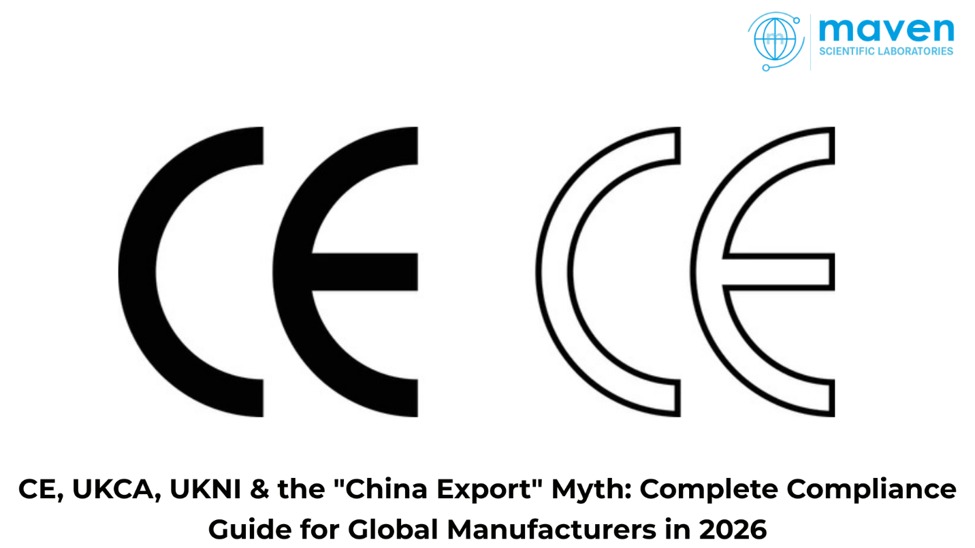
The "China Export" Myth Explained
Among regulatory professionals, few compliance myths have persisted as long as the so-called "China Export" logo.
The story typically claims:
- A separate "China Export" mark exists
- It resembles CE marking
- It provides an alternative compliance route
- Chinese manufacturers use it instead of CE
There is little credible evidence supporting these claims.
Most regulatory experts view the phenomenon as a misunderstanding arising from:
- Poor logo reproduction
- Incorrect spacing between letters
- Misinterpretation of product markings
- Internet-based misinformation
- Historical media repetition
Importantly:
There is no recognized conformity assessment framework known as "China Export."
There is no legal market access granted by such a mark.
There is no regulatory authority administering it.
Why Myth Continues
Several factors contribute to the continued confusion.
1. Similar Visual Appearance
Certain poorly reproduced CE markings may appear visually different from official specifications.
2. Manufacturing Origin Assumptions
Many CE-marked products are manufactured in China, leading some observers to incorrectly associate the mark with country of origin.
3. Regulatory Complexity
Few consumers understand the technical requirements behind conformity assessment systems.
As a result, visual similarities often generate misconceptions.
Common Compliance Risks Associated with Product Markings
Manufacturers frequently encounter several avoidable issues.
1. Incorrect Market Selection
Products designed for one jurisdiction may be exported to another without updating conformity requirements.
2. Documentation Gaps
Organizations may lack:
- Technical files
- Risk assessments
- Testing evidence
- Declarations of Conformity
Marking Misapplication
Common issues include:
- Incorrect logo dimensions
- Improper placement
- Missing accompanying information
- Outdated compliance references
Supply Chain Miscommunication
Manufacturers, importers, and distributors sometimes operate under different assumptions regarding compliance responsibilities.
Best Practices for Global Manufacturers
Organizations should consider implementing the following strategies.
Conduct Early Market Access Assessments
Evaluation:
- Intended markets
- Applicable legislation
- Product classification
- Conformity assessment requirements
Early planning minimizes compliance surprises.
Strengthening Technical Documentation Systems
Well-maintained documentation improves:
- Audit readiness
- Regulatory responsiveness
- Product traceability
- Market surveillance preparedness
Monitor Regulatory Developments
Manufacturers should continuously track:
- Legislative updates
- Guidance revisions
- Market surveillance trends
- Conformity assessment changes
Regulatory intelligence supports long-term compliance sustainability.
Establish Multi-Jurisdiction Compliance Programs
Organizations increasingly require frameworks capable of supporting:
- EU compliance
- UK compliance
- Global market access initiatives
Integrated compliance models improve operational efficiency and scalability.
Emerging Trends in Product Compliance
| Emerging Trend | Regulatory Impact |
| Digital Product Compliance | Increased documentation transparency |
| Enhanced Market Surveillance | Greater enforcement activity |
| Supply Chain Traceability | Stronger accountability expectations |
| Regulatory Intelligence Platforms | Faster adaptation to change |
| Global Harmonization Efforts | Increased standardization opportunities |
| Lifecycle Compliance Management | Continuous oversight requirements |
The future of compliance is becoming increasingly proactive, data-driven, and documentation-focused.
Why Regulatory Readiness Is a Competitive Advantage
The most successful manufacturers will not compete solely through innovation.
They will compete through:
- Regulatory agility
- Compliance maturity
- Market access readiness
- Documentation quality
- Operational resilience
- Customer confidence
Organizations with mature compliance systems can:
- Accelerate product launches
- Reduce regulatory delays
- Strengthen distributor confidence
- Improve supply chain continuity
- Support sustainable growth objectives
How Maven Regulatory Solutions Supports Global Market Access
Our Expertise Includes
- CE marking strategy support
- UKCA compliance assessments
- UKNI regulatory guidance
- Technical documentation reviews
- Product conformity evaluations
- Global market access planning
- Regulatory intelligence monitoring
- Lifecycle compliance management
Why Companies Choose Maven
- Global regulatory expertise
- Science-driven compliance solutions
- End-to-end support models
- Scalable compliance frameworks
- Multi-market regulatory strategies
- Future-focused planning approaches
Conclusion
CE, UKCA, and UKNI may appear closely related, but each serves a distinct legal and regulatory purpose.
Understanding where each marking applies is essential for successful market access and long-term compliance.
Manufacturers that proactively evaluate:
- Target markets
- Conformity assessment obligations
- Documentation readiness
- Technical file quality
- Regulatory intelligence programs
will be better positioned to navigate evolving regulatory expectations.
The strongest compliance programs are no longer reactive.
They are strategic business assets supporting sustainable international growth.
FAQ
1. What is the CE mark?
The CE mark indicates that a product complies with applicable EU legislation and may be placed on the EU and EEA market where required.
2. What is UKCA?
UKCA is the conformity marking used for products placed on the Great Britain market following Brexit.
3. What is UKNI?
UKNI is used alongside CE in Northern Ireland when mandatory third-party conformity assessment has been conducted by a UK-approved body.
4. Can UKNI be used by itself?
No. UKNI must always accompany CE and cannot be used independently.
5. Is "China Export" an official conformity mark?
There is no recognized regulatory conformity framework or official market-access system known as "China Export." The concept is generally regarded as a misunderstanding linked to incorrect CE mark reproductions.

Post a comment