
May 14, 2026
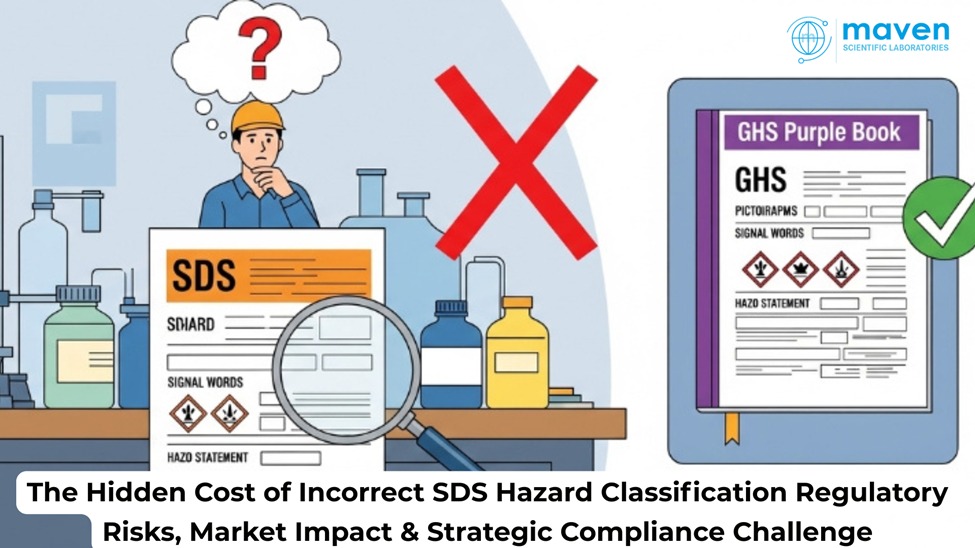
How Incorrect SDS Hazard Classification Can Impact Compliance, Market Access, and Business Continuity
For many organizations, Safety Data Sheet (SDS) hazard classification has traditionally been viewed as a routine documentation task completed during product registration or regulatory updates.
However, under evolving EU CLP regulations and stricter global chemical safety expectations, incorrect hazard classification is no longer just a documentation issue.
It has become a major:
- Regulatory risk
- Operational challenge
- Financial liability
- Market access concern
- Supply chain vulnerability
As regulators increase focus on:
- Endocrine disruptors
- Environmental persistence
- PBT/vPvB substances
- Lifecycle chemical safety
- Scientific substantiation
companies face growing pressure to ensure SDS classifications remain:
- Accurate
- Scientifically defensible
- Continuously updated
Incorrect hazard classification can trigger consequences far beyond SDS Section 2, including:
- Product relabeling
- Market delays
- PCN/UFI resubmissions
- Supply chain disruption
- Product recalls
- Increased liability exposure
- Regulatory enforcement actions
For manufacturers, importers, distributors, and formulators, proactive SDS classification management is now essential for long-term compliance and business continuity.
Why SDS Hazard Classification Is Becoming More Complex
The EU CLP framework is evolving toward more advanced and science-driven hazard assessment methodologies.
Recent updates introduced new hazard classes including:
- Endocrine Disruptors (Human Health)
- Endocrine Disruptors (Environment)
- PBT/vPvB substances
- PMT/vPvM substances
Unlike traditional classifications based mainly on concentration thresholds, these newer hazard classes require more advanced scientific interpretation.
New Classification Approaches Increasing Complexity
| Scientific Requirement | Compliance Impact |
| Weight of Evidence (WoE) assessments | Greater expert evaluation |
| Scientific literature reviews | Continuous monitoring obligations |
| QSAR & in silico modeling | Specialized interpretation |
| Read-across methodologies | Increased documentation scrutiny |
| Environmental persistence analysis | Expanded ecological assessments |
This shift toward evidence-based evaluation significantly increases both the difficulty and the risk of incorrect classification decisions.
The Ripple Effect of Incorrect Classification
A single SDS classification error rarely remains isolated.
Misclassification often affects:
- Product labels
- PCN & UFI notifications
- Transportation compliance
- Customer communication
- Supply chain documentation
- Regulatory submissions
- Product stewardship activities
As regulatory systems become increasingly interconnected, even minor inconsistencies can create widespread operational disruption.
Regulatory & Enforcement Risks
Incorrect classification can quickly lead to regulatory non-compliance.
Authorities across the EU increasingly focus on:
- Classification accuracy
- Scientific robustness
- Data traceability
- Documentation consistency
- Ongoing hazard reassessment
Key EU CLP Deadlines Increasing Pressure
| Deadline | Compliance Focus |
| May 2025 | Substance classification updates |
| May 2026 | Mixture classification obligations |
| November 2026 | Expanded notification expectations |
| May 2028 | Full lifecycle compliance transition |
Failure to comply may result in:
- Non-compliant SDSs
- Incorrect labels
- Failed inspections
- Product recalls
- Administrative penalties
- Restricted market access
Market Access & Commercial Impact
Incorrect classification can directly affect a company’s ability to launch or maintain products in global markets.
Potential impacts include:
- Delayed EU product launches
- UFI & PCN resubmissions
- Relabeling requirements
- Reformulation costs
- Shipment delays
- Customer approval disruptions
Market Risks Associated with Misclassification
| Business Area | Potential Consequence |
| EU product registration | Delayed approvals |
| Distribution networks | Shipment interruptions |
| Customer relationships | Loss of confidence |
| Product portfolios | Increased reformulation costs |
| Regulatory audits | Expanded investigations |
In highly regulated industries, inaccurate hazard communication can significantly damage customer trust and commercial relationships.
Supply Chain & Operational Risks
Many organizations still rely heavily on supplier SDS data without sufficient verification.
This creates risks such as:
- Outdated supplier classifications
- Conflicting SDS versions
- Inconsistent hazard communication
- Weak REACH data integration
- Poor upstream visibility
One incorrect supplier classification can impact multiple downstream products and customers.
The Hidden Cost of Reactive Corrections
Correcting SDS errors after products enter the market is often far more expensive than proactive validation.
What begins as an SDS update may quickly expand into:
- Label redesign
- Packaging replacement
- Customer notifications
- Technical reassessments
- Regulatory resubmissions
- Internal audits
Hidden Costs of Incorrect Classification
| Compliance Activity | Operational Impact |
| SDS revisions | Resource-intensive updates |
| Label redesign | Packaging & printing costs |
| Scientific reassessments | Additional expert reviews |
| Product reformulation | Increased R&D expenses |
| Regulatory resubmissions | Delayed timelines |
In many cases, the total cost of reactive correction greatly exceeds the cost of early compliance preparation.
Why This Challenge Is Growing
Modern hazard assessment increasingly focuses on:
- Long-term systemic effects
- Environmental persistence
- Bioaccumulation
- Endocrine activity
- Chronic exposure risks
These evaluations require:
- Cross-disciplinary expertise
- Continuous scientific review
- Advanced toxicological interpretation
- Ongoing lifecycle monitoring
Organizations delaying compliance preparation face increasing cumulative risk as new CLP deadlines approach.
The Smarter Compliance Strategy: Prevention Over Correction
Forward-looking companies are shifting toward proactive SDS governance.
Best Practices for SDS & CLP Compliance
Conduct Portfolio-Wide Gap Assessments
Identify:
- High-risk substances
- Legacy classifications
- Data gaps
- Regulatory exposure areas
Validate Supplier Data Proactively
Implement:
- Supplier review programs
- Scientific alignment assessments
- Data verification procedures
Modernize SDS & Labeling Systems
Digital compliance systems improve:
- Version control
- Audit readiness
- Regulatory traceability
- Data consistency
Monitor Regulatory Changes Continuously
CLP requirements will continue evolving, making ongoing regulatory intelligence essential.
How MAVEN Supports SDS & CLP Compliance
Our Expertise Includes
- SDS authoring & review
- CLP hazard classification
- GHS compliance support
- Weight of Evidence assessments
- PCN & UFI compliance
- REACH alignment reviews
- Labeling strategy
- Regulatory intelligence monitoring
Why Companies Choose MAVEN
- Science-driven compliance strategies
- Global chemical regulatory expertise
- End-to-end compliance support
- Proactive lifecycle management
- Operational efficiency focus
Conclusion
Incorrect SDS hazard classification is no longer a minor technical issue.
Under evolving EU CLP regulations, it has become a major business risk capable of affecting:
- Regulatory compliance
- Market access
- Supply chain continuity
- Product portfolios
- Financial performance
- Corporate reputation
As hazard classifications and scientific expectations continue expanding, organizations must move beyond reactive correction toward:
Proactive, lifecycle-based classification governance
The key question is no longer:
“Are your SDS classifications compliant today?”
It is:
“Will your classifications remain scientifically defensible tomorrow?”
FAQ
1. What is SDS hazard classification?
SDS hazard classification is the process of identifying and categorizing the physical, health, and environmental hazards of a chemical substance or mixture under regulations such as EU CLP and GHS.
2. Why is correct hazard classification important?
Correct classification affects regulatory compliance, labeling, worker safety, market access, and supply chain communication. Incorrect classification can lead to recalls, fines, and enforcement actions.
3. What are the new EU CLP hazard classes?
Recent updates include Endocrine Disruptors, PBT/vPvB substances, and PMT/vPvM substances, which require more advanced scientific evaluation.
4. What are the risks of incorrect SDS classification?
Risks include non-compliant SDSs, failed inspections, product relabeling, delayed market access, supply chain disruption, and increased liability exposure.
5. Which SDS sections are commonly affected?
Classification errors often impact:
- Section 2: Hazard Identification
- Section 3: Composition
- Section 11: Toxicological Information
- Section 12: Ecological Information
6. What is the Weight of Evidence (WoE) approach?
A WoE approach evaluates multiple scientific data sources together, including toxicology studies, REACH dossiers, QSAR modeling, and environmental assessments.
7. How can companies reduce SDS classification risks?
Companies can reduce risks through proactive supplier validation, scientific review systems, regulatory monitoring, digital compliance infrastructure, and lifecycle-based classification management.

Post a comment