
April 10, 2026
Introduction: OSHA SDS Requirements Under Hazard Communication Standard (HCS)
The Occupational Safety and Health Administration (OSHA) mandates the use of Safety Data Sheets (SDS) under 29 CFR 1910.1200 Appendix D, forming a core component of the Hazard Communication Standard (HCS).
The SDS framework ensures that chemical hazards are clearly communicated across the supply chain, enabling employers, workers, and downstream users to identify risks, implement safety controls, and respond effectively to emergencies.
Under the 2026 regulatory landscape, SDS compliance is increasingly aligned with Globally Harmonized System (GHS) standards, emphasizing structured data presentation, hazard classification, and lifecycle chemical safety management.
What is OSHA SDS requirements under 1910.1200 Appendix D?
OSHA SDS requirements mandate a 16-section format for Safety Data Sheets, including identification, hazard classification, composition, and toxicological information, ensuring proper hazard communication in workplaces.
Regulatory Overview: OSHA 1910.1200 Appendix D
| Regulatory Element | Details |
| Standard | OSHA Hazard Communication Standard (HCS) |
| Regulation | 29 CFR 1910.1200 Appendix D |
| Scope | Mandatory SDS format & content |
| Applicability | All hazardous chemicals in workplace |
| Alignment | GHS (Globally Harmonized System) |
SDS must include Sections 1–11 and 16 (mandatory), while Sections 12–15 are non-mandatory but recommended for comprehensive safety communication.
SDS Structure: Mandatory 16-Section Format
Sections 1–11 & 16 (Mandatory Content)
| Section | Title | Key Information |
| 1 | Identification | Product details, supplier info, emergency contact |
| 2 | Hazard Identification | GHS classification, hazard statements, pictograms |
| 3 | Composition | Chemical ingredients, CAS numbers, concentration |
| 4 | First-Aid Measures | Exposure routes, symptoms, treatment |
| 5 | Fire-Fighting Measures | Extinguishing media, hazards, PPE |
| 6 | Accidental Release | Spill response, containment methods |
| 7 | Handling & Storage | Safe handling, storage conditions |
| 8 | Exposure Controls | PEL, TLV, PPE, engineering controls |
| 9 | Physical & Chemical Properties | Key physicochemical parameters |
| 10 | Stability & Reactivity | Hazardous reactions, incompatibilities |
| 11 | Toxicological Information | Health effects, toxicity data |
| 16 | Other Information | SDS revision date, updates |
Sections 12–15 (non-mandatory but recommended)
| Section | Content Area |
| 12 | Ecological Information |
| 13 | Disposal Considerations |
| 14 | Transport Information |
| 15 | Regulatory Information |
Although not enforced by OSHA, these sections are critical for global compliance (REACH, GHS, transport regulations).
Detailed Breakdown of Key SDS Sections
1. Identification
- Product identifier & synonyms
- Manufacturer/importer details
- Emergency contact information
- Recommended uses & restrictions
2. Hazard Identification
- GHS classification
- Signal words (Danger/Warning)
- Hazard & precautionary statements
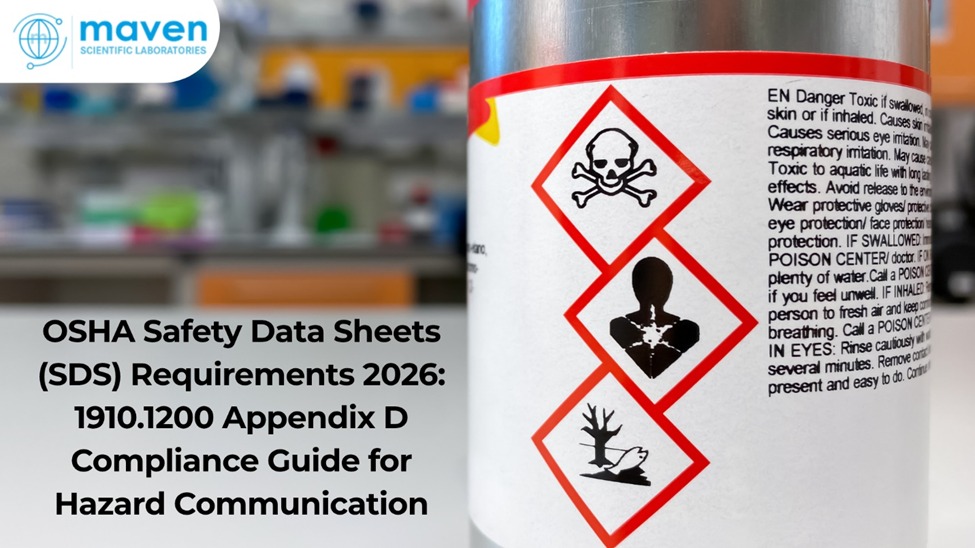
- Pictograms (e.g., flame, skull & crossbones)
- Unknown toxicity disclosure
3. Composition / Information on Ingredients
| Category | Requirements |
| Substances | Chemical name, CAS number, impurities |
| Mixtures | Ingredient concentration, classification |
| Trade Secrets | Disclosure statement required |
Transparency in ingredient disclosure is critical for hazard classification and risk assessment.
4–6. Emergency Response Sections
- First Aid Measures: Exposure-specific treatment
- Fire-Fighting Measures: Hazardous Combustion Risks
- Accidental Release: Spill containment and PPE
7–8. Handling, Storage & Exposure Controls
- Safe handling procedures
- Storage conditions & incompatibility
- Occupational exposure limits (PEL, TLV)
- Engineering controls and PPE
9–11. Scientific & Toxicological Data
| Section | Focus Area |
| Physical & Chemical Properties | Boiling point, pH, solubility, flash point |
| Stability & Reactivity | Hazardous reactions & decomposition |
| Toxicology | Acute/chronic toxicity, carcinogenicity |
Inclusion of scientific data ensures evidence-based hazard communication.
16. Other Information
- SDS preparation or revision date
- Version control and updates
Key Compliance Requirements Under OSHA SDS (2026)
- All SDS must follow standardized 16-section format
- Missing data must be clearly marked as “not available”
- Trade secret claims must comply with 1910.1200(i)
- SDS must be readily accessible to employees
- Regular updates required based on new hazard data
2026 Trends in SDS & Hazard Communication Compliance
- Digital SDS management systems (eSDS platforms)
- AI-driven chemical hazard classification tools
- Global harmonization with GHS Rev. 9+ updates
- Integration with workplace safety software
- Enhanced focus on toxicological data transparency
- Real-time SDS access via QR codes and cloud systems
Strategic Compliance Approach for Industry
To ensure OSHA SDS compliance, organizations should:
- Develop GHS-compliant SDS documentation
- Implement centralized SDS management systems
- Conduct hazard classification and risk assessments
- Ensure employee training under Hazard Communication Standard
- Maintain up-to-date SDS with latest scientific data
- Align with global regulatory frameworks (REACH, WHMIS, GHS)
Strategic Insight
SDS is no longer just a compliance document, it is a critical risk management tool.
Organizations leveraging digitization, automation, and regulatory intelligence will achieve:
- Better workplace safety outcomes
- Reduced regulatory risks
- Improved global compliance readiness
Frequently Asked Questions
Q1. What is OSHA 1910.1200 Appendix D?
It defines the mandatory format and content requirements for Safety Data Sheets (SDS).
Q2. Are all 16 sections mandatory?
Sections 1–11 and 16 are mandatory; Sections 12–15 are optional but recommended.
Q3. What happens if data is unavailable?
The SDS must clearly state “no applicable information available.”
Q4. Is SDS required for all chemicals?
Yes, for all hazardous chemicals used in workplaces.
Conclusion
The OSHA SDS Requirements under 1910.1200 Appendix D provide a globally harmonized, structured framework for chemical hazard communication. As regulatory expectations evolve in 2026, companies must adopt a proactive, digital-first, and compliance-driven approach to SDS management.
Ensuring accurate, complete, and accessible SDS documentation is essential for worker safety, regulatory compliance, and operational excellence.

Post a comment