
June 07, 2025
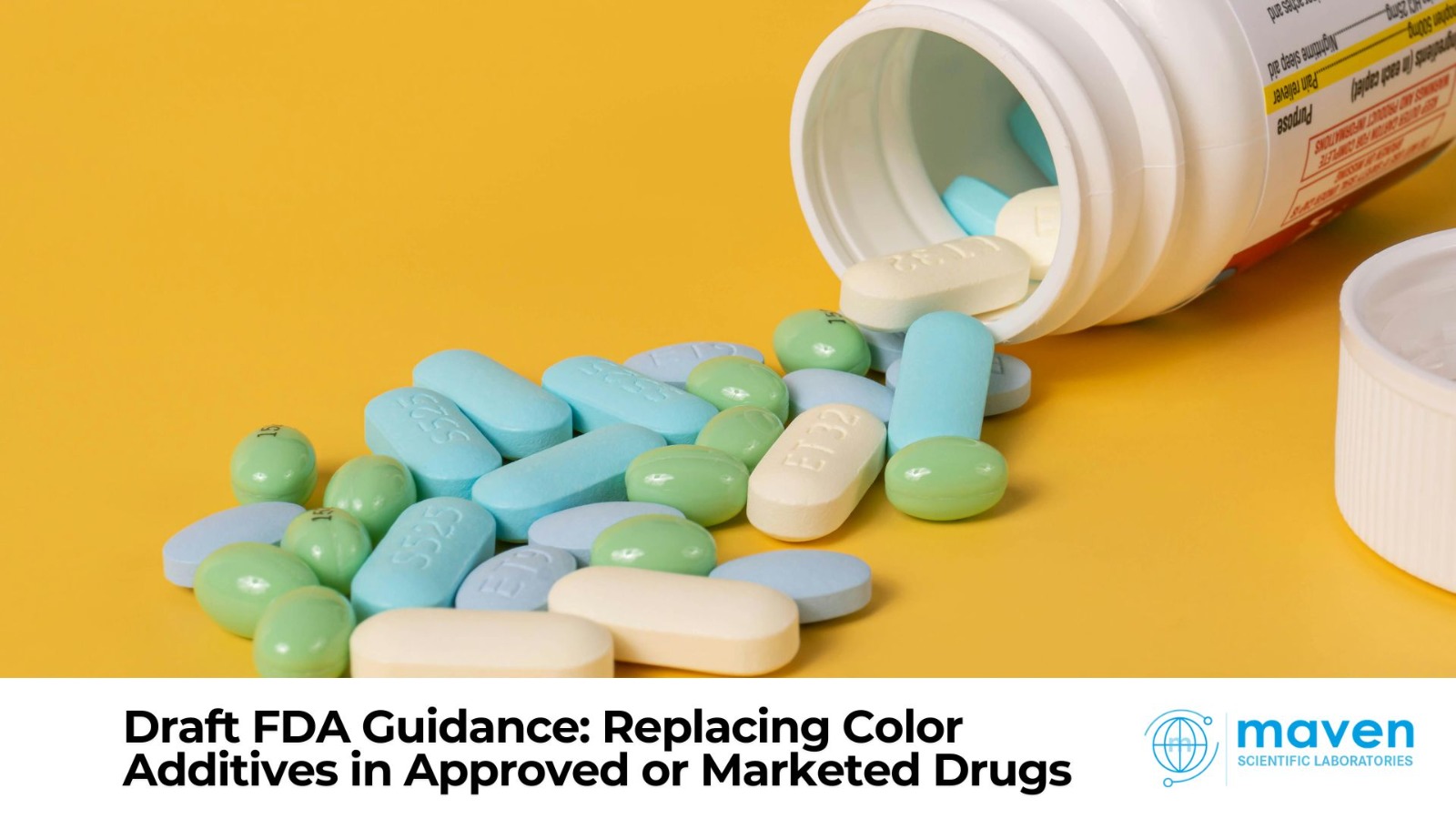
Color additives play a critical role in pharmaceutical products not just for aesthetics, but for product identification, patient compliance, and brand differentiation.
However, manufacturers may need to replace color additives due to:
- Safety concerns
- Supply chain disruptions
- Quality or stability issues
- Regulatory updates
To streamline this process, the U.S. Food and Drug Administration released draft guidance titled:
“Replacing Color Additives in Approved or Marketed Drug Products”
This guidance introduces a more flexible and efficient regulatory pathway, reducing approval timelines while maintaining product safety and quality.
What is the FDA guidance on replacing color additives in drugs?
The FDA draft guidance allows most color additive changes in approved drugs to be submitted via the CBE-30 pathway instead of prior approval, provided the change does not impact safety, efficacy, or product quality
Why This Guidance Matters
Historically, replacing a color additive was considered a major post-approval change, requiring:
- Prior Approval Supplement (PAS)
- Lengthy FDA review timelines
These have created delays in addressing safety or supply issues.
The new draft guidance shifts most color changes to a moderate-risk category, enabling faster implementation.
Key Regulatory Change: Easier Approval Pathway
From PAS to CBE-30
Old vs New Approach
| Aspect | Previous Requirement | New Guidance |
| Change Type | Major | Moderate |
| Submission | PAS | CBE-30 |
| Timeline | Lengthy approval | 30-day implementation |
| Flexibility | Limited | Increased |
What is CBE-30?
- Changes Being Affected in 30 Days (CBE-30) allows manufacturers to:
- Implement changes after 30 days of FDA notification
- Avoid waiting for full prior approval
This significantly accelerates product updates and supply continuity.
Scope: Who This Applies To
The guidance applies to a wide range of pharmaceutical products:
- New Drug Applications (NDAs)
- Abbreviated New Drug Applications (ANDAs)
- Over the Counter (OTC) monograph drugs
- Certain compounded drugs under Section 503B of the FD&C Act
This broad applicability ensures industry-wide impact.
Conditions for Using the CBE-30 Pathway
Manufacturers can use the faster pathway if all conditions are met:
Key Requirements
- The new color additive is FDA-approved (listed under 21 CFR Parts 70–82)
- No impact on:
- Safety
- Effectiveness
- Bioavailability
- Total excipient change is ≤ 5% of unit dose weight
CBE-30 Eligibility Criteria
| Criterion | Requirement |
| Regulatory status | Approved color additive |
| Safety impact | No change |
| Efficacy impact | No change |
| Excipient variation | ≤ 5% |
| Product performance | Unaffected |
Meeting these criteria ensures risk-controlled flexibility.
When Prior Approval Is Still Required
Not all changes qualify for the simplified pathway.
Situations Requiring PAS
- Products intended for sensitive populations (e.g., neonates, pediatrics)
- Use of non-approved color additives
- Changes exceeding 5% excipient threshold
- Any modification affecting product quality or performance
These cases still demand full regulatory review.
Removing vs Replacing Color Additives
Removal (Without Replacement)
- Considered a minor change
- Can be reported in Annual Report
- No supplement submission required
Replacement
- Typically, a moderate change (CBE-30)
- Requires supporting data and documentation
This distinction reduces regulatory burden for simpler changes.
Documentation & Quality Requirements
Even with a simplified pathway, robust documentation is essential.
Key Requirements
- Update labeling and product description
- Provide minimum 3 months’ stability data:
- Long-term (room temperature)
- Accelerated conditions
- Demonstrate:
- No impact on quality
- Consistent product performance
Documentation Checklist
| Requirement | Purpose |
| Stability data | Ensure shelf-life integrity |
| Label updates | Regulatory compliance |
| Quality evidence | Maintain product standards |
| Change records | Audit readiness |
Impact on Pharmaceutical Industry
1. Faster Time-to-Market
- Rapid implementation of formulation updates
2. Supply Chain Flexibility
- Easier substitution of unavailable color additives
3. Reduced Regulatory Burden
- Fewer PAS submissions
4. Improved Compliance Efficiency
- Clear guidance reduces ambiguity
Industry Impact
| Area | Benefit |
| Regulatory | Faster approvals |
| Operations | Increased flexibility |
| Quality | Maintained standards |
| Market | Improved continuity |
Best Practices for Manufacturers
- Conduct thorough risk assessments before changes
- Verify regulatory status of color additives
- Maintain strong change control systems
- Ensure cross-functional coordination (QA, RA, R&D)
- Keep documentation audit-ready
- Monitor post-implementation performance
Common Challenges
- Interpreting eligibility for CBE-30
- Generating sufficient stability data quickly
- Managing global regulatory differences
- Ensuring consistency across multiple markets
The Road Ahead
The FDA’s draft guidance reflects a broader trend towards:
- Risk-based regulatory approaches
- Operational flexibility for manufacturers
- Faster response to supply and safety issues
Similar frameworks may emerge in other regulatory regions.
Conclusion
The FDA’s draft guidance on replacing color additives marks a significant step toward regulatory efficiency in pharmaceutical post-approval changes.
By allowing most changes through the CBE-30 pathway, the FDA enables manufacturers to:
- Respond quickly to safety and supply challenges
- Maintain product quality and compliance
- Reduce regulatory delays
A proactive, well-documented approach will ensure organizations fully benefit from this streamlined pathway while maintaining compliance.
FAQs
1. What is the CBE-30 pathway?
A regulatory pathway allowing implementation of changes 30 days after FDA notification.
2. Do all color changes require FDA approval?
No, many can now be submitted as moderate changes under CBE-30.
3. When is prior approval required?
For high-risk changes or use of non-approved additives.
4. Is removing a color additive a major change?
No, it is considered a minor change.
5. What data is required for color changes?
Stability data, labeling updates, and quality impact assessment.
6. Who does this guidance apply to?
NDA, ANDA, OTC drugs, and certain compounded products.

Post a comment