
November 29, 2024
Introduction: The Rising Demand for Safe Aesthetic Injectables
The global aesthetic medicine market has experienced significant expansion in recent years, driven by increasing demand for non-surgical cosmetic procedures. Among these procedures, dermal fillers have emerged as one of the most widely adopted minimally invasive treatments for facial rejuvenation, wrinkle reduction, and tissue valorization.
However, while dermal fillers offer aesthetic benefits with minimal downtime, their safety profile requires rigorous toxicological evaluation and strict regulatory oversight before reaching patients. Ensuring safety is not solely about cosmetic outcomes, it involves scientific validation, toxicology risk assessment, biocompatibility evaluation, and regulatory compliance with global health authorities.
Organizations such as Maven Regulatory Solutions play a crucial role in supporting manufacturers by providing expert consulting, regulatory strategy development, product safety evaluation, and compliance guidance across international markets.
This article explores the science of dermal fillers, regulatory frameworks governing injectable aesthetics, potential safety risks, and the critical role of toxicology risk assessments in ensuring product safety and regulatory approval.
Understanding Dermal Fillers in Aesthetic Medicine
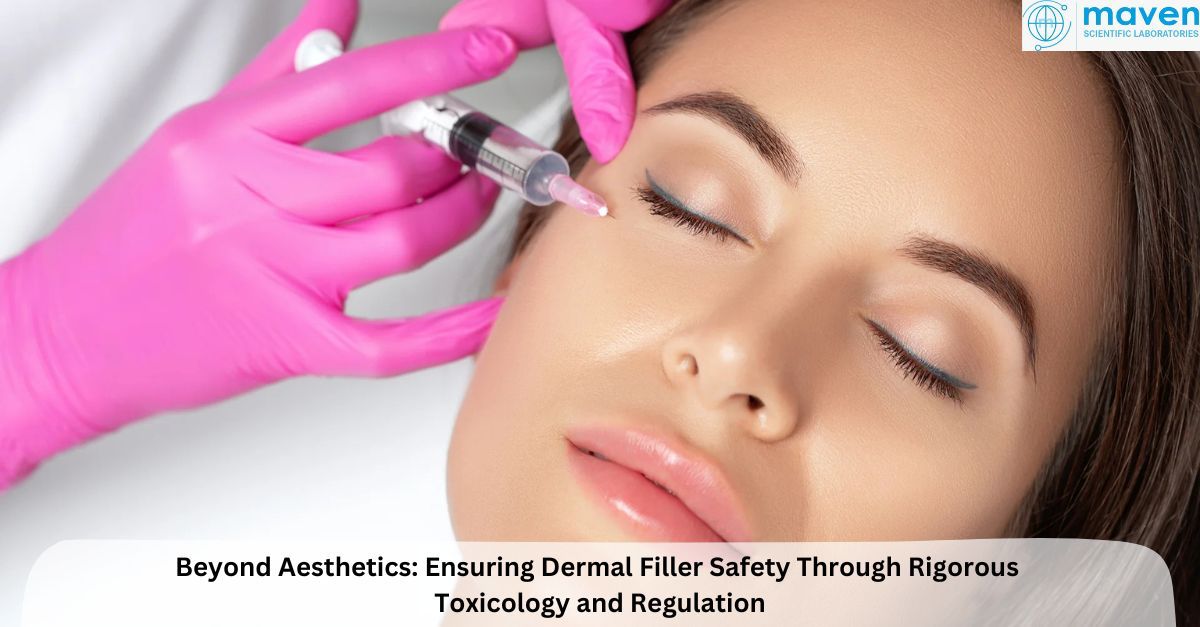
Dermal fillers are injectable biomaterials designed to restore lost facial volume, smooth wrinkles, enhance facial contours, and improve skin elasticity. They are commonly used in facial aesthetic procedures to address age-related tissue changes and structural volume loss.
Common Treatment Areas
Dermal fillers are frequently used for:
- Nasolabial folds
- Lip augmentation
- Cheek valorization
- Jawline contouring
- Tear through correction
- Marionette lines
- Hand rejuvenation
These procedures are typically performed in outpatient aesthetic clinics and dermatology practices, requiring precise product safety profiles and validated clinical performance.
Types of Dermal Fillers and Material Composition
Dermal fillers are categorized based on material composition and biodegradability.
| Dermal Filler Category | Material Composition | Duration | Safety Considerations |
| Hyaluronic Acid (HA) Fillers | Cross-linked hyaluronic acid polymers | 6–18 months | High biocompatibility, reversible with hyaluronidase |
| Poly-L-Lactic Acid (PLLA) | Synthetic biodegradable polymer | Up to 2 years | Stimulates collagen production |
| Calcium Hydroxyapatite (CaHA) | Microspheres in gel carrier | 12–18 months | Used for deeper tissue augmentation |
| Polymethylmethacrylate (PMMA) | Permanent microspheres | Long-lasting | Requires strict safety evaluation |
Among these, hyaluronic acid dermal fillers remain the most used due to their natural presence in human connective tissues and favorable safety profile.
Clinical Benefits of Dermal Fillers
Dermal fillers are widely adopted due to their non-surgical convenience and rapid aesthetic outcomes.
Key Advantages
1. Facial Rejuvenation
Fillers restore structural support lost due to age-related collagen depletion and fat pad atrophy.
2. Immediate Results
Unlike surgical procedures, dermal fillers provide visible results immediately after injection.
3. Minimal Recovery Time
Most treatments involve minimal downtime, allowing patients to return to daily activities quickly.
4. Customizable Aesthetic Outcomes
Injectable fillers allow precision contouring of facial structures, offering tailored treatment outcomes.
Safety Risks Associated with Dermal Fillers
Despite their widespread use, dermal fillers carry potential clinical and toxicological risks, making comprehensive safety evaluation essential.
Common Adverse Reactions
- Injection-site swelling
- Bruising
- Erythema
- Localized inflammation
- Mild discomfort
Serious Complications
| Risk Category | Description | Clinical Impact |
| Vascular Occlusion | Accidental injection into blood vessels | Tissue necrosis or blindness |
| Filler Migration | Movement from injection site | Asymmetry and tissue distortion |
| Allergic Reactions | Immune response to filler components | Hypersensitivity reactions |
| Granuloma Formation | Chronic inflammatory response | Long-term tissue complications |
These risks highlight the need for rigorous toxicology testing, biocompatibility studies, and regulatory review prior to market approval.
Regulatory Framework Governing Dermal Fillers
Dermal fillers are regulated as medical devices or combination products in many jurisdictions.
Global Regulatory Authorities
| Regulatory Authority | Region | Regulatory Framework |
| FDA | United States | Medical Device Regulation / PMA pathway |
| EMA | European Union | EU Medical Device Regulation (EU MDR 2017/745) |
| Health Canada | Canada | Medical Device Licensing |
| TGA | Australia | Therapeutic Goods Administration |
These agencies require extensive clinical safety data, toxicology evaluations, and manufacturing compliance documentation.
Importance of Toxicology Risk Assessment for Dermal Fillers
Toxicology risk assessment ensures that injectable products are safe for human exposure and free from harmful biological responses.
Core Components of Dermal Filler Toxicological Evaluation
1. Biocompatibility Testing
Evaluates compatibility of filler materials with human tissue according to ISO 10993 biological evaluation standards.
Tests include:
- Cytotoxicity testing
- Sensitization testing
- Irritation testing
- Systemic toxicity evaluation
2. Chemical Characterization
Assessment of:
- Polymer composition
- Degradation products
- Residual solvents
- Cross-linking agents
3. Toxicological Risk Profiling
Determines exposure limits using:
- Permitted Daily Exposure (PDE)
- Threshold of Toxicological Concern (TTC)
- Occupational Exposure Limits (OEL)
4. Long-Term Safety Evaluation
Examine biodegradation pathways and metabolic clearance to ensure breakdown products do not pose toxicological risks.
Maven Regulatory Solutions: Expertise in Dermal Filler Safety and Compliance
Maven Regulatory Solutions supports cosmetic and aesthetic manufacturers through specialized toxicology consulting and regulatory strategy services designed to ensure dermal filler safety and regulatory approval.
Key Areas of Expertise
Comprehensive Toxicology Risk Assessments
Maven’s certified toxicologists conduct detailed safety evaluations including:
- Dermal exposure risk assessment
- Extractables and leachables analysis
- Biocompatibility testing strategy development
- Safety margin calculations
Regulatory Strategy and Compliance Consulting
Maven provides regulatory support for:
- FDA dermal filler regulatory submissions
- EU MDR compliance strategy
- Technical documentation preparation
- Global cosmetic regulatory strategy
Analytical Testing and Safety Validation
Maven laboratories conduct advanced testing such as:
- Chemical characterization
- Material safety analysis
- Residual monomer testing
- Stability studies
Post-Market Safety Monitoring
Maven assists manufacturers with:
- Adverse event monitoring
- Risk management plans
- Pharmacovigilance strategies
- Product safety reporting systems
Emerging Trends in Dermal Filler Safety
Recent innovations in aesthetic medicine are shaping regulatory expectations.
Key Industry Trends
| Emerging Trend | Regulatory Impact |
| Bio-stimulatory fillers | Requires extended safety studies |
| Hybrid injectable materials | Increased toxicology characterization |
| AI-assisted aesthetic treatment planning | Enhanced treatment safety |
| Personalized aesthetic formulations | Regulatory data complexity |
Global regulators are increasingly emphasizing risk-based safety evaluations and comprehensive toxicological assessments.
Why Manufacturers Choose Maven Regulatory Solutions
Organizations developing injectable aesthetic products partner with Maven for:
- Global regulatory expertise
- Advanced toxicology capabilities
- Comprehensive safety evaluation frameworks
- Regulatory submission support
- Post-market compliance strategies
Maven’s multidisciplinary team ensures that dermal fillers meet international safety standards while accelerating regulatory approval timelines.
Conclusion
Dermal fillers continue to transform the aesthetic medicine industry by providing effective, minimally invasive facial rejuvenation solutions. However, ensuring their safety requires a robust framework of toxicological risk assessment, scientific validation, and regulatory compliance.
Through specialized expertise in cosmetic toxicology, regulatory consulting, and safety evaluation, Maven Regulatory Solutions plays a critical role in supporting manufacturers across the dermal filler development lifecycle.
By combining scientific rigor, regulatory insight, and advanced analytical capabilities, Maven helps ensure that dermal fillers entering the market meet the highest standards of patient safety, product efficacy, and regulatory compliance.
Frequently Asked Questions
What regulatory classification does dermal fillers fall under?
In most jurisdictions, dermal fillers are regulated as medical devices or combination products, requiring safety data, toxicology evaluation, and regulatory approval before commercialization.
Why is toxicology risk assessment important for dermal fillers?
Toxicology assessments evaluate biocompatibility, chemical safety, and exposure risks, ensuring injectable materials do not cause adverse biological responses.
What testing is required for dermal filler safety?
Common testing includes cytotoxicity testing, sensitization testing, systemic toxicity evaluation, chemical characterization, and stability studies.
What is biocompatibility testing in dermal fillers?
Biocompatibility testing evaluates whether dermal filler materials interact safely with human tissues without causing irritation, toxicity, or immune responses.
How can manufacturers ensure dermal filler regulatory compliance?
Manufacturers must perform toxicology risk assessments, clinical safety studies, quality system compliance, and regulatory submissions to relevant health authorities.

Post a comment