
November 22, 2024
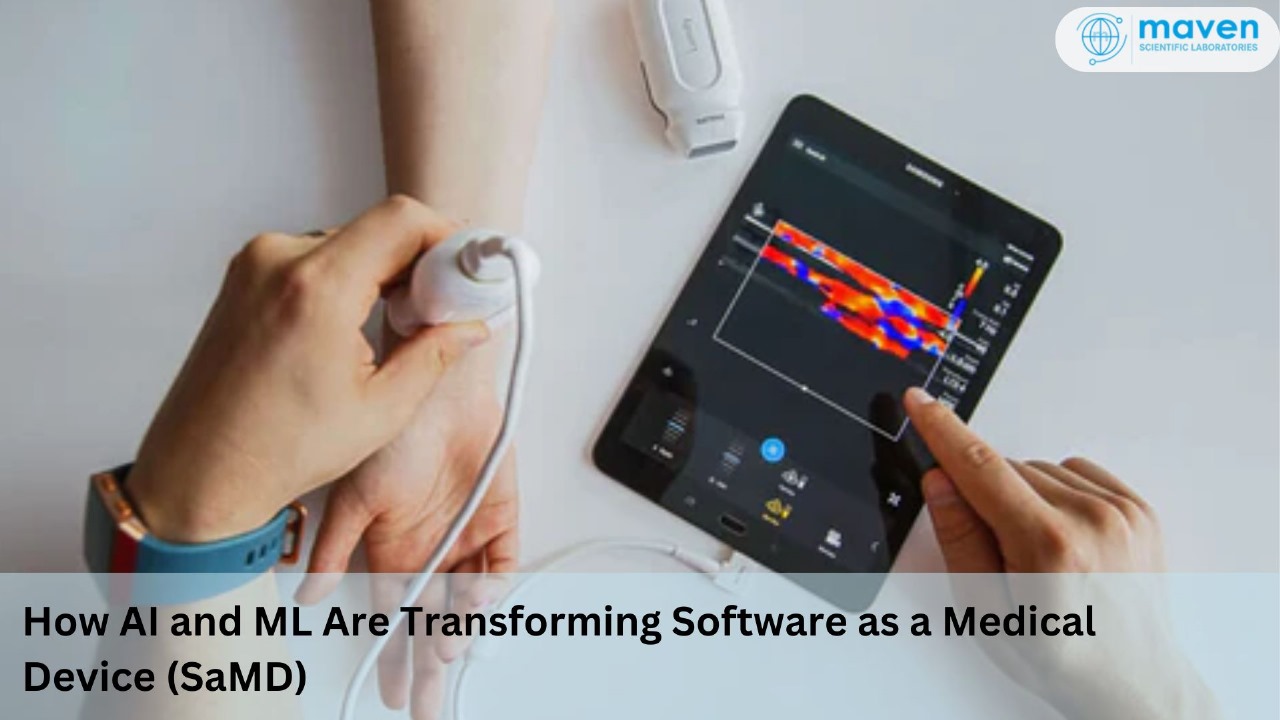
Artificial Intelligence (AI) and Machine Learning (ML) are redefining the landscape of Software as a Medical Device (SaMD) a category of medical software intended for medical purposes without being part of a physical hardware device. As global regulatory bodies refine digital health frameworks, AI-driven SaMD solutions are transforming diagnostics, predictive analytics, patient monitoring, and personalized treatment planning.
Regulatory authorities such as the U.S. Food and Drug Administration (FDA) and the European Medicines Agency (EMA) continue to evolve policies addressing AI-enabled medical software, adaptive algorithms, and real-world performance monitoring.
This comprehensive guide explores the technical foundations of AI/ML in SaMD, use cases, regulatory pathways, risk management requirements, validation strategies, and how Maven Regulatory Solutions supports global compliance for AI-driven medical technologies.
1. Understanding AI and ML in Software as a Medical Device
AI-powered SaMD systems replicate cognitive tasks such as image interpretation, pattern recognition, speech processing, and predictive modeling. ML algorithms enable software to learn from structured and unstructured datasets to improve performance without explicit reprogramming.
Core Capabilities of AI/ML-Enabled SaMD:
- Predictive analytics for early disease detection
- Automated medical imaging interpretation
- Real-time remote patient monitoring
- Natural language processing (NLP) for EHR analysis
- Personalized therapeutic recommendations
Unlike traditional rule-based software, AI-driven SaMD solutions adapt to evolving datasets, enabling dynamic clinical decision support systems.
2. Technical Architecture of AI/ML in SaMD
2.1 Data Collection and Preprocessing
High-quality data forms the backbone of AI SaMD systems.
| Data Source | Application Area |
| Medical Imaging (CT, MRI, X-ray) | Diagnostic support |
| Electronic Health Records (EHRs) | Risk stratification |
| Wearable Device Data | Continuous monitoring |
| Genomic Data | Precision medicine |
Data preprocessing includes cleaning, normalization, bias mitigation, and anonymization to ensure GDPR and HIPAA compliance.
2.2 Model Development and Training
AI model training involves:
- Labeled dataset integration
- Supervised or unsupervised learning approaches
- Feature selection and engineering
- Hyperparameter optimization
Common algorithms include:
| Algorithm Type | SaMD Use Case |
| Convolutional Neural Networks (CNNs) | Radiology imaging diagnostics |
| Natural Language Processing (NLP) | Clinical documentation analysis |
| Random Forest / Gradient Boosting | Risk prediction modeling |
| Recurrent Neural Networks (RNNs) | Time-series monitoring |
2.3 Validation and Clinical Evaluation
AI-enabled SaMD must undergo:
- Analytical validation
- Clinical performance validation
- Real-world performance testing
- Bias assessment and mitigation
Regulatory frameworks require objective evidence demonstrating safety, efficacy, and reproducibility.
3. Key Use Cases of AI/ML in SaMD
3.1 AI in Medical Imaging
AI-based SaMD detects tumors, fractures, pulmonary nodules, and retinal abnormalities with high sensitivity and specificity. These systems enhance radiologist efficiency and reduce diagnostic variability.
3.2 Predictive Risk Modeling
ML algorithms analyze historical patient data to predict cardiovascular disease risk, diabetic complications, and oncology progression supporting early intervention strategies.
3.3 Remote Patient Monitoring (RPM)
AI-driven SaMD integrated with IoT and wearable devices enables real-time detection of arrhythmias, glucose fluctuations, and respiratory irregularities.
3.4 Personalized Medicine and Genomics
AI interprets genomic sequencing data to guide targeted therapy decisions, especially in oncology and rare disease management.
3.5 Virtual Health Assistants
NLP-enabled digital assistants enhance medication adherence, symptom tracking, and patient engagement.
4. Regulatory Framework for AI/ML-Enabled SaMD
Global regulatory authorities are refining digital health oversight models.
4.1 Good Machine Learning Practice (GMLP)
Regulators encourage adherence to GMLP principles emphasizing:
- Data integrity
- Algorithm transparency
- Bias mitigation
- Reproducibility
- Robust documentation
4.2 FDA AI/ML Action Plan
The FDA promotes a Total Product Lifecycle (TPLC) approach that includes:
- Predetermined Change Control Plans (PCCPs)
- Continuous learning oversight
- Post-market real-world performance monitoring
4.3 EU Medical Device Regulation (MDR)
Under EU MDR 2017/745:
- AI SaMD may require CE marking
- Clinical evaluation reports (CER) are mandatory
- Post-market surveillance (PMS) plans must be established
- Risk management must align with ISO 14971
4.4 Core Compliance Standards
| Standard | Relevance |
| ISO 13485 | Quality Management Systems |
| ISO 14971 | Risk Management |
| IEC 62304 | Medical Software Lifecycle |
| IEC 62366 | Usability Engineering |
| GDPR / HIPAA | Data Privacy & Security |
5. Regulatory Challenges in AI-Driven SaMD
5.1 Data Bias and Representativeness
Unbalanced datasets can lead to discriminatory outcomes and inaccurate predictions.
5.2 Algorithm Transparency and Explainability
Deep learning “black box” models pose interpretability challenges. Regulators increasingly require explainable AI (XAI).
5.3 Model Drift and Continuous Learning
As clinical data evolves, performance degradation may occur. Structured retraining protocols and validation cycles are mandatory.
5.4 Cybersecurity and Data Protection
SaMD systems must be implemented:
- Encryption protocols
- Secure API integration
- Real-time cybersecurity monitoring
5.5 Cost and Infrastructure Complexity
Development and regulatory validation of AI SaMD require significant investment in:
- Clinical trials
- Performance validation studies
- Regulatory documentation
- Post-market surveillance systems
6. Emerging Trends in AI/ML SaMD (2024–2025)
- Federated learning for privacy-preserving model training
- Explainable AI (XAI) frameworks for regulatory transparency
- Real-world evidence (RWE) integration
- Adaptive AI regulatory sandboxes
- AI-driven pharmacovigilance signal detection
- Digital twin technologies in personalized care
These advancements are shaping next-generation digital health compliance strategies.
7. Maven Regulatory Solutions: AI SaMD Compliance Partner
Maven Regulatory Solutions provides comprehensive regulatory support for AI-enabled Software as a Medical Device.
Our Expertise Includes:
- Global regulatory strategy (FDA, EU MDR, UKCA)
- Clinical evaluation report (CER) preparation
- Risk management documentation (ISO 14971)
- Software lifecycle documentation (IEC 62304)
- AI validation and performance testing strategy
- Post-market surveillance and real-world performance monitoring
- Regulatory submission dossier preparation
Maven ensures that AI-driven SaMD innovations meet evolving global regulatory expectations while accelerating time-to-market.
Frequently Asked Questions (FAQ)
Q1: What qualifies as AI-based SaMD?
Software that performs medical functions independently and uses AI/ML algorithms for diagnosis, monitoring, or treatment recommendations.
Q2: Do adaptive AI systems require regulatory reapproval?
Yes. Significant algorithm modifications may require regulatory notification or reapproval depending on jurisdiction.
Q3: What is Predetermined Change Control Plan (PCCP)?
A regulatory framework allowing controlled AI updates within pre-approved parameters.
Q4: Is clinical validation mandatory for AI SaMD?
Yes. Clinical performance evidence is required to demonstrate safety and effectiveness.
Q5: What is the biggest regulatory challenge for AI SaMD?
Balancing continuous learning capabilities with strict validation, transparency, and safety requirements.
Conclusion
AI and ML are revolutionizing Software as a Medical Device by enabling predictive diagnostics, intelligent automation, and personalized healthcare delivery. However, innovation must align with rigorous regulatory frameworks, quality standards, cybersecurity safeguards, and real-world performance monitoring.
Organizations developing AI-driven SaMD must implement structured validation strategies, maintain lifecycle documentation, and adopt proactive compliance frameworks to achieve global regulatory approvals.
Maven Regulatory Solutions empowers digital health innovators with expert regulatory guidance, AI validation strategy, and end-to-end compliance support ensuring that transformative SaMD technologies reach patients safely, efficiently, and compliantly in global markets.

Post a comment