
January 09, 2026
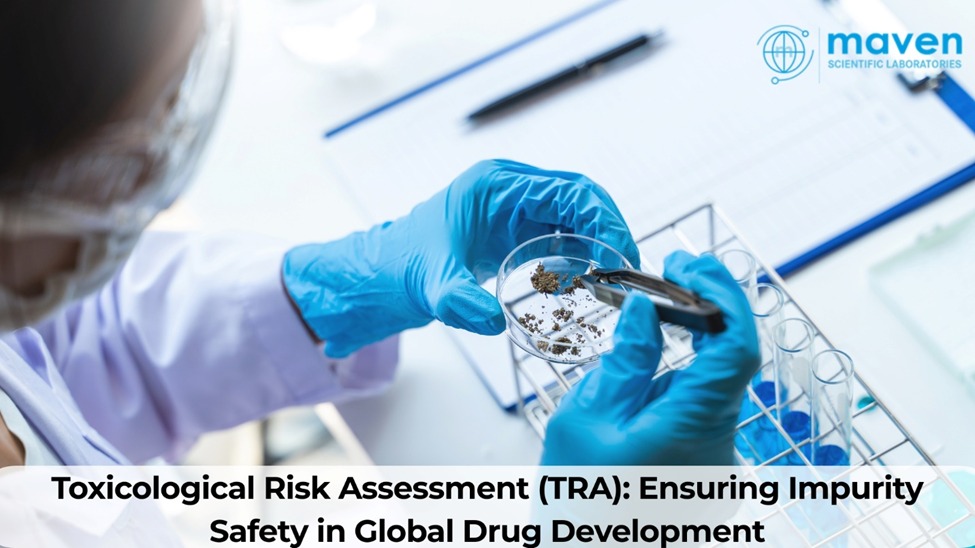
In modern pharmaceutical development, patient safety does not stop at product approval. Even trace-level impurities can pose serious health risks if not scientifically evaluated and controlled. This is where Toxicological Risk Assessment (TRA) becomes a critical regulatory and safety function.
With evolving global regulations such as ICH M7, ICH Q3A/B/C/D, and increased regulatory scrutiny from agencies including the FDA, EMA, and other global authorities, manufacturers must demonstrate a science-based justification for impurity limits throughout the product lifecycle.
At Maven Regulatory Solutions, we support pharmaceutical and life sciences companies with regulator-accepted, submission-ready Toxicological Risk Assessments, ensuring compliance while enabling efficient product development and approvals.
What Is Toxicological Risk Assessment (TRA)?
Toxicological Risk Assessment (TRA) is a structured scientific evaluation used to assess the potential health risks associated with impurities present in drug substances, drug products, and packaging systems.
A robust TRA evaluates:
- Chemical and toxicological hazards
- Dose–response relationships
- Patient exposure levels
- Overall risk characterization
TRA is commonly applied to:
- Genotoxic and mutagenic impurities
- Process-related and degradation impurities
- Residual solvents
- Elemental impurities
- Extractables & Leachable (E&L)
The objective is to ensure that impurity levels remain within acceptable safety thresholds, such as Acceptable Daily Intake (ADI) or Permitted Daily Exposure (PDE).
Regulatory Expectations for Toxicological Risk Assessment
Global regulatory agencies expect TRA reports to align with internationally harmonized guidelines.
Key Regulatory Guidelines Governing TRA
|
Guideline |
Scope |
|
ICH M7 |
Genotoxic impurities (PGIs) |
|
ICH Q3A / Q3B |
Organic impurities in drug substances and products |
|
ICH Q3C |
Residual solvents |
|
ICH Q3D |
Elemental impurities |
|
VICH GL18 |
Veterinary medicinal product impurities |
Failure to comply with these expectations can result in regulatory queries, delayed approvals, or rejection of submissions.
Core Components of a Toxicological Risk Assessment
A compliant and regulator-accepted TRA typically includes the following components:
Hazard Identification
Identification of toxicological hazards based on chemical structure, published literature, databases, and regulatory precedents.
Dose–Response Assessment
Evaluation of toxicity thresholds using NOAEL, LOAEL, TTC, PDE, or ADI approaches.
Exposure Assessment
Calculation of patient exposure considering dose, duration, route of administration, and target population.
Risk Characterization
Integration of hazard and exposure data to conclude whether the impurity poses an acceptable or unacceptable risk.
Toxicological Risk Assessment Services at Maven Regulatory Solutions
Maven Regulatory Solutions provides end-to-end TRA support for global regulatory submissions across development and lifecycle stages.
Impurity-Specific Risk Assessments
- Genotoxic Impurities Risk Assessment (ICH M7-compliant)
- Drug Substance Impurities (ICH Q3A)
- Drug Product Impurities (ICH Q3B)
- Residual Solvents Risk Assessment (ICH Q3C)
- Elemental Impurities Risk Assessment (ICH Q3D)
- Extractables & Leachable (E&L) from Container Closure Systems
- Veterinary Medicinal Product Impurities (VICH GL18)
Scientific Methodologies Used in TRA
Maven applies scientifically robust and regulator-accepted methodologies to support defensible risk conclusions.
Advanced Toxicological Tools & Techniques
- Read-across approaches using structural and toxicological analogs
- Weight-of-evidence (WoE) evaluations
- QSAR modeling aligned with ICH M7 expectations:
- Statistical-based models
- Rule-based expert systems
- Literature-based toxicological justification
- Threshold of Toxicological Concern (TTC) approach where applicable
All assessments are reviewed by qualified toxicologists and supported with complete datasets.
Acceptable Daily Intake (ADI) & PDE Derivation
For impurities exceeding specification limits or lacking established thresholds, Maven supports:
- Derivation of ADI or PDE values
- Justification for non-ICH listed elemental impurities
- Documentation suitable for regulatory submissions and audits
Nonclinical Study Planning & Toxicological Qualification
When existing data is insufficient, Maven provides strategic support for:
- Planning and design of nonclinical toxicology studies
- Study oversight and data interpretation
- Toxicological qualification reports
- Integration into IND, NDA, ANDA, MAA, and variation filings
TRA Coverage Across Product Lifecycle
|
Development Stage |
TRA Application |
|
Early Development |
Impurity identification and screening |
|
Clinical Phase |
Genotoxic risk justification |
|
Registration |
Submission-ready TRA reports |
|
Post-Approval |
Change control and lifecycle updates |
Why Maven Regulatory Solutions?
Maven Regulatory Solutions combines toxicological expertise, regulatory intelligence, and scientific rigor to deliver TRA solutions that are:
- Globally complaint
- Regulator-accepted
- Scientifically defensible
- Audit-ready
- Customized to product complexity
Our goal is to reduce regulatory risk while accelerating development timelines.
Conclusion
Toxicological Risk Assessment is no longer a supporting activity it is a regulatory necessity and patient safety cornerstone. With increasing impurity scrutiny and global harmonization, companies need expert-driven, submission-ready TRA strategies.
Maven Regulatory Solutions partners with organizations to deliver high-quality toxicological assessments that support compliance, confidence, and successful regulatory outcomes.
FAQs: Toxicological Risk Assessment
1. Why is TRA mandatory for regulatory submissions?
TRA demonstrates that impurity levels are scientifically justified and safe for patients, meeting global regulatory expectations.
2. What is the biggest regulatory focus area in TRA?
Genotoxic impurities under ICH M7 receive the highest scrutiny.
3. Can QSAR be used instead of animal studies?
Yes. Regulatory-accepted QSAR and read-across approaches are encouraged when scientifically justified.
4. When is ADI derivation required?
When impurities exceed limits or lack established safety thresholds.
5. Does TRA apply post-approval?
Yes. TRA is essential for lifecycle management, variations, and change control.

Post a comment