
October 15, 2025
The European Union (EU) has officially phased out the Rabbit Pyrogen Test (RPT) in 2025, marking a decisive step in the global movement toward animal-free, scientifically advanced pyrogen testing methods. While the transition supports the 3Rs principle (Replacement, Reduction, Refinement of animal testing), it raises critical scientific and regulatory considerations for the pharmaceutical and medical device industries, particularly for blood-derived products and complex biological formulations.
Pyrogens and the Role of Testing in Patient Safety
Pyrogens are fever-inducing substances that present significant risks when introduced via parenteral administration.
Their detection is central to ensuring the safety of:
- Injectable pharmaceuticals and biologics
- Medical devices with blood contact
- Advanced therapy medicinal products (ATMPs) and blood-derived products
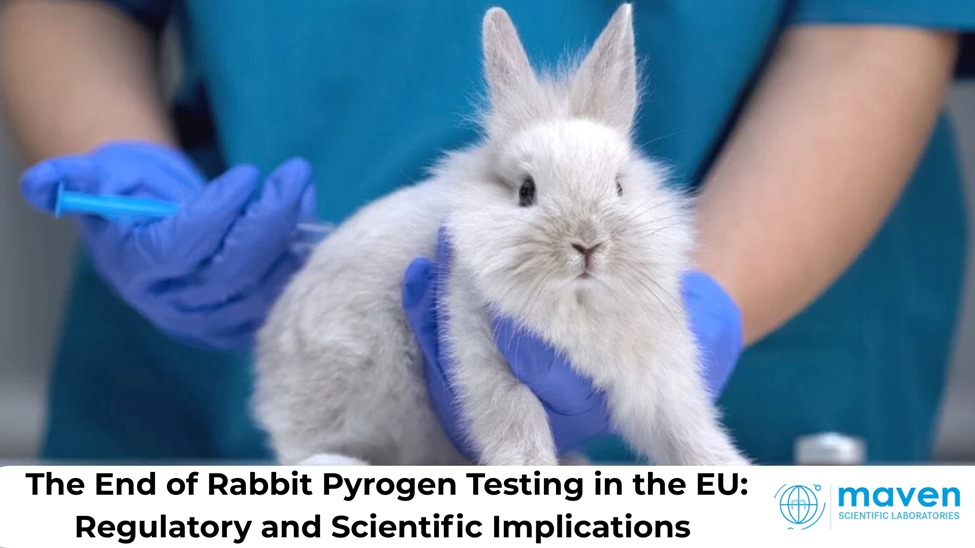
For decades, the Rabbit Pyrogen Test (RPT) was the global gold standard for detecting both endotoxin and non-endotoxin pyrogens. In this method, rabbits were injected with the test article, and a febrile response indicated pyrogenic contamination. Although reliable, RPT was costly, time-intensive, and heavily reliant on animal use.
Alternatives to the Rabbit Pyrogen Test
Over recent decades, validated alternatives have been introduced and widely adopted:
- Limulus Amebocyte Lysate (LAL) Test
- Developed in the 1970s, using horseshoe crab blood to detect bacterial endotoxins.
- Supported by decades of validation and regulatory acceptance.
- Still widely applied, though associated with sustainability concerns due to reliance on crab populations.
- Recombinant Factor C (rFC) Assays
- Synthetic, animal-free recombinant technology replacing LAL.
- Provides highly specific detection of endotoxins.
- Represents a promising future direction for animal-free endotoxin testing.
- Monocyte Activation Test (MAT)
- Introduced in the 1990s and formally adopted by the European Pharmacopoeia in 2010.
- Uses human peripheral blood mononuclear cells (PBMCs) to detect both endotoxin and non-endotoxin pyrogens.
- Provides a more physiologically relevant in vitro assay and broadens detection beyond endotoxins.
Each advancement reflects a progressive shift toward scientifically robust, non-animal methodologies that align with EU directives and global harmonization goals.
Limitations of Current Alternatives
Despite significant progress, the transition away from RPT introduces challenges:
- Blood-Derived Products: Current assays may not adequately capture non-endotoxin pyrogens, making MAT the preferred but not always sufficient alternative.
- Low Endotoxin Recovery (LER): Certain formulations — particularly those containing buffers, chelating agents (e.g., citrate, phosphate), and surfactants (e.g., polysorbates) — may mask endotoxins, resulting in underestimation of contamination.
- Matrix Interference: Chemical and physical properties of test articles can interfere with MAT, LAL, or rFC assays, creating risk of false negatives or inconclusive results.
The absence of RPT as a fallback method underscores the need for robust assay validation, matrix-specific risk assessments, and regulatory engagement.
Regulatory and Industry Implications
The EU’s decision represents:
- A regulatory milestone aligning with the global trajectory toward animal-free testing.
- Increased reliance on validated in vitro assays such as MAT and rFC.
- A mandate for industry to adapt pyrogen testing strategies in quality control frameworks.
- A need for global regulatory convergence, particularly with FDA, Health Canada, and other authorities where RPT may still be referenced.
For industry, this transition requires proactive assessment of product portfolios, assay validation strategies, and alignment with European Pharmacopoeia Chapter 2.6.30 (MAT) and Chapter 2.6.14 (Bacterial Endotoxins Test).
Conclusion
The elimination of Rabbit Pyrogen Testing in the EU represents both a scientific advancement and a regulatory challenge. While the decision strongly advances the ethical mandate of the 3Rs, unresolved questions remain regarding assay suitability for blood-derived and complex products.
At Maven Regulatory Solutions, we provide expert guidance to:
- Evaluate and validate alternative pyrogen testing methods (MAT, LAL, rFC).
- Address LER challenges and product-specific assay interference.
- Ensure regulatory compliance with EU and global pharmacopeial standards.
- Develop risk-based strategies for endotoxin and pyrogen detection.
???? With evolving regulations, Maven helps manufacturers transition confidently to next-generation pyrogen testing, safeguarding both regulatory compliance and patient safety.

Post a comment