
December 29, 2025
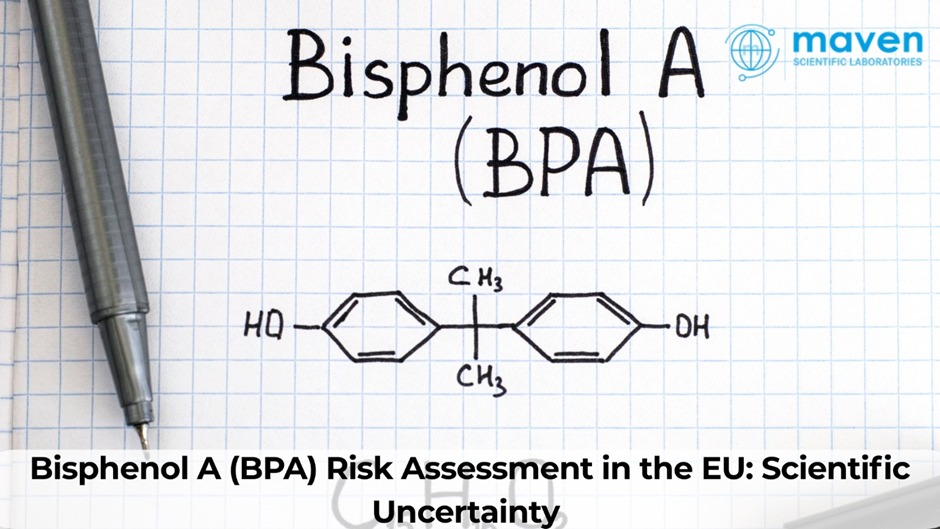
Bisphenol A (BPA) has become one of the most debated substances in modern regulatory toxicology. Used extensively in food contact materials, consumer products, and industrial applications, BPA sits at the intersection of toxicological science, regulatory policy, and public health protection.
What makes the current BPA controversy exceptional is not merely the substance itself, but the unprecedented divergence between expert scientific bodies on what constitutes a tolerable level of human exposure. The magnitude of disagreement now stretches across orders of magnitude, challenging long-standing assumptions about risk assessment methodologies, hazard interpretation, and regulatory decision-making.
For companies operating in the EU or supplying into it this debate is no longer academic. It has direct implications for compliance, product safety strategies, exposure assessments, and future regulatory enforcement.
Maven Regulatory Solutions provides this in-depth analysis to help stakeholders understand the science, regulatory positions, and practical implications of the evolving BPA landscape.
Understanding the Limits of Toxicological Risk Assessment
Toxicological hazard and risk assessment, despite its scientific rigor, is not an exact science. Health-based guidance values such as:
- Tolerable Daily Intake (TDI)
- Permitted Daily Exposure (PDE)
- Acceptable Daily Intake (ADI)
are derived from datasets that inevitably contain biological variability, experimental uncertainty, and interpretive judgment.
Even within the pharmaceutical sector where datasets are often extensive inter-company comparisons of PDE derivations have shown variability:
|
Observation |
Scientific Insight |
|
Up to 3-fold differences |
Considered normal |
|
3–10-fold differences |
Often still regulatory acceptable |
This variability reflects the interpretive nature of applied toxicology, especially when extrapolating from animal models to human health outcomes.
Against this backdrop, some degree of expert disagreement on BPA would be expected. However, the current BPA divergence far exceeds historical norms.
BPA TDI Values: A Regulatory Comparison
Diverging Expert Conclusions
The current controversy stems from radically different conclusions drawn from largely overlapping scientific datasets.
|
Authority |
TDI Value for BPA |
Key Position |
|
EFSA (2023) |
0.2 ng/kg bw/day |
Ultra-low TDI based on immune system effects |
|
German BfR |
0.2 µg/kg bw/day |
1,000× higher than EFSA |
|
EMA |
Disagrees with EFSA methodology |
Questions biological relevance |
|
UK Committee on Toxicity (COT) |
Adopted BfR TDI |
Seeks regulatory pragmatism |
This three-order-of-magnitude gap is virtually unprecedented in EU food and chemical safety risk assessment.
The Core Scientific Dispute: Immune System Effects
At the heart of the debate lies EFSA’s interpretation of subtle immune system changes observed in animal studies specifically, alterations in a single immune cell population in mice.
EFSA’s Position
- These cellular changes are assumed to be predictive of adverse health outcomes
- A highly conservative uncertainty framework was applied
- Resulted in the lowest BPA TDI ever established
Opposing Scientific View
Regulatory and scientific bodies opposing EFSA argue that:
- The observed immune changes lack clear adversity
- No definitive causal link to clinical disease is established
- Extrapolation to human health risk is scientifically uncertain
This disagreement is not about data availability but about how precautionary regulatory toxicology should be.
Exposure Estimates: Why the Numbers Matter
EFSA’s own exposure assessment further complicates the picture.
|
Scenario |
EFSA TDI (ng/kg/day) |
BfR TDI (µg/kg/day) |
|
Mean dietary exposure |
Exceeds TDI by 100–1,000× |
Below or near limit |
|
95th percentile exposure |
Exceeds TDI across all age groups |
Generally compliant |
This means:
- Under EFSA’s approach, widespread regulatory non-compliance is implied
- Under BfR’s approach, most exposures remain acceptable
The divergence has major implications for food contact materials, packaging, and compliance strategies.
What This Means for EU Regulatory Policy
The BPA case has become a test case for broader EU chemicals policy:
- Precautionary principle vs. proportionality
- Hazard-based vs. risk-based regulation
- Scientific uncertainty vs. regulatory certainty
It also aligns with wider EU initiatives on:
- Endocrine disruptors
- Substances of Concern (SoC)
- REACH and CLP reform
- Food contact material regulation updates
For industry, this signals a future of lower tolerance thresholds, stronger data expectations, and increased scrutiny.
Industry Implications: What Companies Should Do Now
Companies using or supplying BPA-containing materials should act proactively:
Key Action Areas
- Conduct BPA presence and exposure inventories
- Review food contact compliance documentation
- Monitor EFSA, BfR, EMA, and UK positions closely
- Prepare for potential substitution or reformulation
- Engage early with regulatory strategy experts
How Maven Regulatory Solutions Can Support You
Maven Regulatory Solutions provides end-to-end regulatory intelligence and compliance support, including:
- BPA and endocrine disruptor risk assessments
- EU food contact material regulatory strategy
- Exposure modelling and compliance gap analysis
- Scientific dossier review and regulatory positioning
- REACH, CLP, and chemicals policy monitoring
Our experts help clients navigate scientific uncertainty with regulatory confidence.
Frequently Asked Questions (FAQ)
1. Is BPA currently banned in the EU?
No. BPA is subject to strict regulatory controls, but it is not universally banned across all applications.
2. Why is EFSA’s TDI so much lower than others?
EFSA adopted a highly precautionary interpretation of immune system effects observed in animal studies.
3. Should companies comply with the lowest TDI now?
Companies should assess risk strategically, monitor regulatory developments, and prepare for future enforcement scenarios.
4. Will BPA restrictions increase in the future?
Given the regulatory trend toward precaution and endocrine disruptor control, further restrictions are likely.
Conclusion: Turning Regulatory Uncertainty into Strategic Advantage
The BPA controversy highlights a critical reality: regulatory toxicology is evolving faster than ever. Companies that rely solely on historical compliance assumptions risk being caught unprepared.
By proactively monitoring developments, reassessing exposure, and aligning with emerging regulatory expectations, businesses can protect market access, ensure compliance, and gain a competitive advantage.
Maven Regulatory Solutions stands ready to support your journey through this complex regulatory landscape.

Post a comment